

An unusually direct public exchange between two prominent figures on Iran’s political right is exposing a deeper debate in Tehran over a question that has become increasingly urgent after months of war: should negotiations with the United States be treated as a necessary instrument for ending the conflict, or as a trap that could surrender leverage Iran believes it gained on the battlefield?
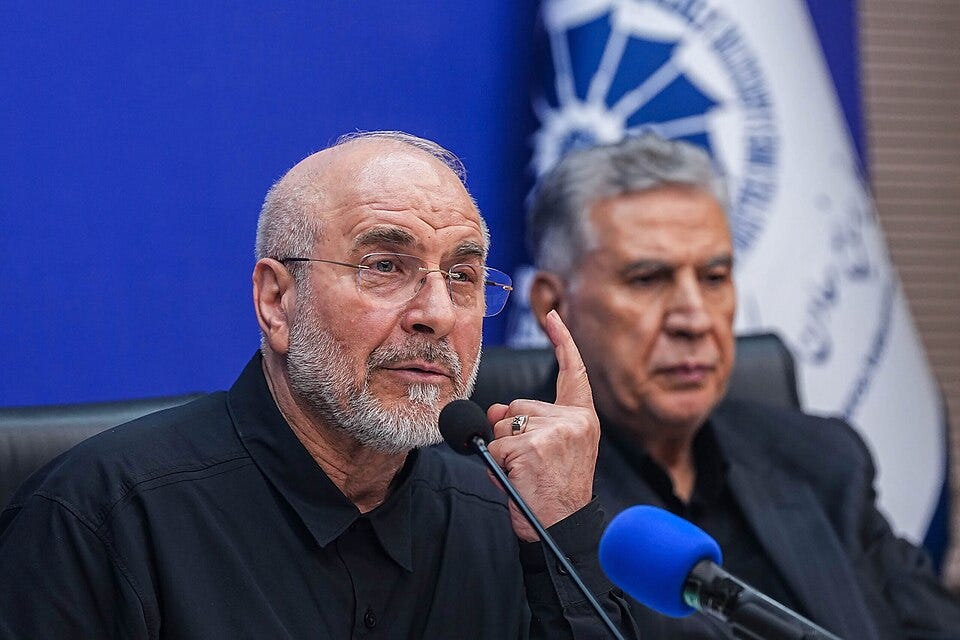
The dispute erupted after Hossein Shariatmadari, editor-in-chief of the hardline Kayhan newspaper and a longtime influential voice among Iran’s conservative establishment, published a note addressed to Mohammad Bagher Ghalibaf, the parliament speaker who also leads Iran’s negotiating team with the United States.
_as_the_special_representative_for_China.jpg)
Shariatmadari’s criticism was carefully framed. He described Ghalibaf as a committed revolutionary with a long record of service, but warned that some of his recent positions appeared - at least superficially - to overlap with those of reformists and figures Kayhan routinely labels “pro-Western.” He suggested that these groups were attempting to shift Ghalibaf’s political base and urged him to state his revolutionary positions more explicitly.
The message was difficult to separate from Kayhan’s broader campaign against the emerging diplomatic track. Days earlier, the newspaper accused senior Iranian officials of sending Washington “signals of weakness and passivity” by emphasizing the economic costs of the conflict and the desirability of ending the war. Kayhan specifically objected to arguments that Iran cannot indefinitely sustain military confrontation while its population faces severe economic pressure. In the newspaper’s telling, presenting Iran with a choice between war and negotiations - or between military strength and economic welfare - accepts a false framework created by Iran’s adversaries.
Ghalibaf has now answered publicly, and his response amounts to one of his clearest defenses yet of negotiations with Washington.
“Negotiations, in my view, have neither intrinsic value nor are they taboo,” Ghalibaf wrote. They are neither inherently good nor inherently bad, he argued, but become useful when they advance national interests, secure Iranian rights and preserve gains achieved through resistance.
More significantly, Ghalibaf rejected the idea that diplomacy and resistance necessarily stand in opposition. Negotiations conducted from a position of strength, he argued, can themselves constitute part of the struggle rather than a retreat from it.
His language remained firmly within the ideological vocabulary of the Islamic Republic. Ghalibaf stressed his opposition to “Westernization,” repeatedly invoked Iran’s military resistance and portrayed the United States as an enemy responsible for Iranian deaths. But within that framework, he drew a clear distinction between engagement and capitulation.
He also delivered an unusually pointed criticism of those attacking the negotiating process from the sidelines, arguing that refusing responsibility for negotiations while waiting to label any resulting achievement a betrayal amounts to political risk avoidance.
The exchange matters because Ghalibaf is not a reformist advocating rapprochement with the West. He comes from the Revolutionary Guard, has spent much of his political career in the conservative establishment and currently heads the team negotiating on behalf of the Iranian state. His argument therefore represents something more consequential than the familiar reformist case for diplomacy: it is an attempt to establish negotiations with Washington as legitimate within the political vocabulary of the Islamic Republic itself.
President Masoud Pezeshkian is making essentially the same case from a different political tradition. Speaking during a three-hour economic meeting at Iran’s Central Bank as the government confronts Washington’s new economic pressure campaign, Pezeshkian said Wednesday that Iran’s approach is to resolve disputes through “understanding, interaction and negotiations.” At the same time, he insisted that Tehran would resist economic pressure and argued that Washington would fail to achieve through sanctions what it had failed to accomplish militarily.
That combination - openness to negotiations alongside claims of continued resistance - increasingly appears to be the government’s preferred political formula.
It also comes as regional diplomacy accelerates. Field Marshal Asim Munir, Pakistan’s army chief, visited Tehran this week and met Pezeshkian, Ghalibaf and Supreme National Security Council Secretary Mohsen Rezaei. A senior official in Pezeshkian’s office subsequently described the visit as “very fruitful” and containing “very valuable diplomatic achievements,” adding that its results would soon become apparent.
Iranian reporting citing a source close to the negotiating team indicates that Munir heard Iran’s conditions for renewed negotiations and then conveyed them to Washington. That report has not been independently confirmed. Yet the same diplomatic activity that Pezeshkian’s office is presenting as productive is being portrayed very differently elsewhere inside Iran.
Kayhan on Wednesday described the visits by Munir and Omani Foreign Minister Badr Al Busaidi as part of a new American “deception operation.” It portrayed Munir as effectively carrying out a U.S. mission designed to lure Iran back to negotiations while Washington maintains military and economic pressure. The newspaper argued that it is Washington — not Tehran — that now needs diplomacy because of the costs of the conflict and disruptions surrounding the Strait of Hormuz.
The disagreement is therefore no longer simply about whether Iran should negotiate. It is increasingly about how Iran interprets the outcome of the war itself.
For Kayhan and like-minded hardliners, Iran emerged with significant leverage, particularly through its ability to disrupt navigation and energy flows through the Strait of Hormuz. From that perspective, returning to negotiations under American economic pressure risks giving away at the negotiating table what Iran paid heavily to obtain through military confrontation.
Pezeshkian and Ghalibaf are advancing a different argument: military resistance and diplomacy do not have to be mutually exclusive. Iran can claim that it resisted American pressure while still using negotiations to convert whatever leverage it possesses into an agreement that reduces the danger of renewed war and relieves economic pressure.
The economic costs of the confrontation are increasingly difficult to separate from the political debate over diplomacy. Pezeshkian made his latest appeal for negotiations not at the Foreign Ministry but during a Central Bank meeting focused on the currency, inflation, trade and household economic conditions.
The debate also complicates a common outside depiction of Iranian politics as divided neatly between officials who favor confrontation and those who favor accommodation. Ghalibaf’s position illustrates a third argument now taking shape: negotiations can be defended not as an alternative to resistance, but as one way of converting military leverage into political and economic gains.
Whether that argument ultimately prevails will depend significantly on Washington. Tehran’s internal advocates of negotiations will have a much harder time defending diplomacy if the United States demands terms that can easily be portrayed inside Iran as capitulation, or if economic pressure intensifies while negotiations proceed without tangible benefits.
Conversely, a diplomatic process that produces visible reciprocal steps could strengthen those arguing that Iran does not have to choose between defending its interests and negotiating with an adversary.
For ordinary Iranians, this is more than an ideological argument inside the political establishment. The outcome could help determine whether the country moves toward another cycle of military confrontation and deeper economic isolation, or whether the current regional diplomacy opens a path back toward an agreement. The striking development this week is that the argument for testing that path is no longer coming only from Iran’s reformists. It is now being made publicly by the president and by the conservative former Revolutionary Guard commander entrusted with negotiating on Iran’s behalf.