

The domestic Iranian political debate surrounding the recent Iran–U.S. memorandum has entered a fundamentally different phase. During the negotiations, the principal divide inside Iran centered on whether engagement with the United States should occur at all. Since the agreement was announced, and particularly after the controversy surrounding hardline parliamentarian Mahmoud Nabavian’s leaked remarks, it has become increasingly clear that the memorandum enjoys the backing of Iran’s core decision-making institutions. Consequently, the country’s political debate has shifted away from the legitimacy of diplomacy itself toward questions of implementation, political messaging, and how to maximize the agreement’s benefits while minimizing its risks.
.jpg)
This transformation is visible across much of Iran’s political spectrum. Senior officials, reformists, pragmatic conservatives, economists, and even some traditionally anti-American commentators increasingly acknowledge that the war has altered Iran’s strategic environment. While disagreements remain over the scope of engagement with Washington and the level of trust that should be placed in the United States, the dominant question is no longer whether diplomacy should continue, but how it should be managed.
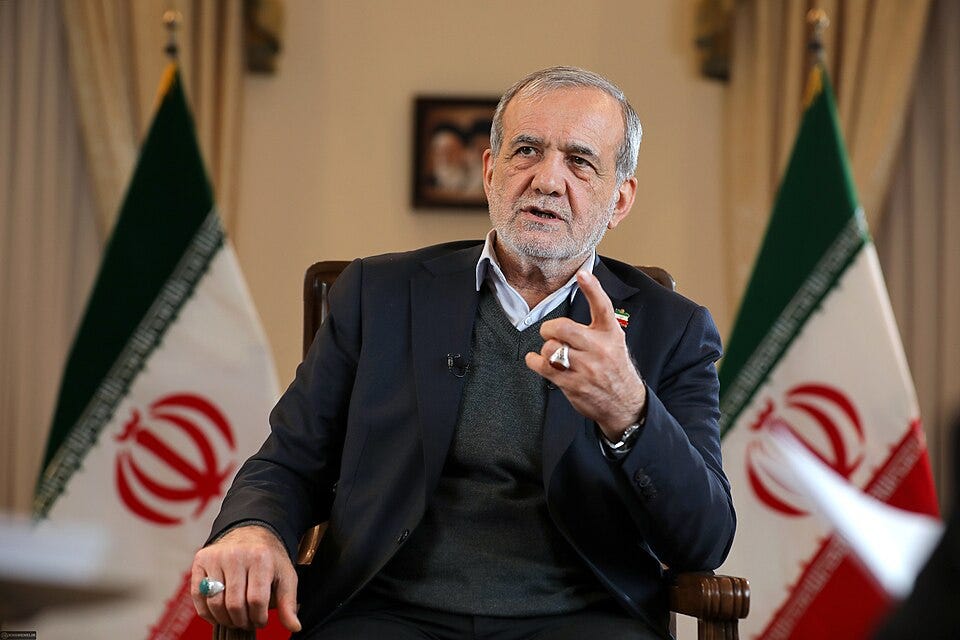
One of the clearest indicators of this shift has been the emergence of an unusually coordinated official narrative. President Masoud Pezeshkian, Parliament Speaker Mohammad Bagher Ghalibaf, Foreign Minister Abbas Araghchi, Judiciary Chief Gholamhossein Mohseni-Ejei, and Central Bank Governor Abdolnaser Hemmati have all delivered variations of the same message: the memorandum was approved through Iran’s established decision-making institutions, negotiations do not constitute surrender to the United States, and domestic political divisions should not weaken Iran’s negotiating position.
President Pezeshkian provided the strongest institutional defense of the agreement by revealing that more than 90 percent of participants in the Supreme National Security Council initially supported the memorandum and, after further deliberations, all members ultimately voted in favor despite limited disagreements. His remarks framed the agreement not as the project of a single administration but as the outcome of a broad consensus within Iran’s national security establishment.
Ghalibaf sought to counter domestic criticism by dismissing President Donald Trump’s repeated claim that Iran would use its unfrozen assets to purchase American agricultural products. He characterized Trump’s comments as messaging aimed at domestic American audiences and sarcastically remarked that the United States could keep its “GMO soybeans, broken promises, and trash talks.” His broader argument, however, was that Iran alone would determine how its released assets are spent and had accepted no externally imposed purchasing obligations.
Judiciary Chief Mohseni-Ejei similarly argued that “negotiation in no way means surrender to the United States,” while urging politicians and media figures to avoid rhetoric that could create the appearance of deep internal divisions at a sensitive moment in the diplomatic process.
Beyond official institutions, some influential conservative voices have also begun defending diplomacy from a position of strategic realism rather than ideological moderation. Among the most prominent has been conservative journalist Vahid Ashtari, who argued that Iran’s recent experience demonstrated the limits of prolonged confrontation. While criticizing the government’s communication strategy, Ashtari maintained that the Iranian public deserves an honest assessment of the country’s military, economic and strategic constraints rather than slogans detached from reality. He pointed to the economic costs of the recent conflict, pressures on Iran’s oil exports, and the limitations of sustained escalation with the United States. His comments are particularly notable because they defend diplomacy not from a reformist perspective, but from within conservative political thought based on a calculation of Iran’s national interests.
Economic debates have undergone an equally significant transformation. Trump’s assertion that Iran would purchase American agricultural products with its released assets quickly became one of the most discussed political controversies inside Iran. Yet the debate revealed that disagreements were increasingly centered on economic strategy rather than ideological opposition to engagement with the United States.
Central Bank Governor Abdolnaser Hemmati emphasized that the memorandum contains no provision obligating Iran to purchase American agricultural goods. He explained that the first tranche of released assets remains governed by the humanitarian framework negotiated during the Biden administration, while future released funds could finance a broader range of non-sanctioned imports. At the same time, Hemmati argued that if American products offer better prices or quality, rejecting them solely for ideological reasons would not serve Iran’s national interests.
Several economists went even further. Economist Sadegh Hosseini argued that purchasing American agricultural products such as corn, soybeans, and wheat could actually strengthen diplomacy by creating economic stakeholders within the United States who would benefit from stable bilateral relations. In his view, import decisions should be guided by price, quality, and national economic interests, not ideology.
Political analyst Ali Afshari similarly noted that Iran has continued importing American medicines, medical equipment, chemicals, and limited food products even during periods of maximum sanctions. According to Afshari, trade with the United States should not be treated as an ideological taboo but evaluated according to the interests of Iranian consumers and the broader economy.
The same logic had been advanced even before the current memorandum. Economist Hadi Kahalzadeh, writing for the Quincy Institute for Responsible Statecraft months earlier, argued that any durable U.S.–Iran agreement should deliberately include mutually beneficial commercial incentives. He suggested that expanding American exports in sectors such as agriculture, civil aviation, and automobiles would create influential constituencies inside the United States with an economic interest in preserving diplomacy, making future agreements more politically sustainable in both countries.
However, not everyone in Iran is open to expanding trade with the United States. Former Deputy Culture Minister Mohammad Ali Ramin argued that importing American agricultural products would expose Iranians to genetically-modified food and even characterized such imports as a form of biological warfare. His criticism focused on what he claimed Washington wanted rather than on the memorandum itself, acknowledging that no such obligation appears in the agreement.
The Reform Front of Iran, meanwhile, offered one of the strongest endorsements of the memorandum. The coalition praised President Pezeshkian and the negotiating team for reducing tensions and protecting Iran’s national interests while arguing that the agreement should become the starting point for broader economic reforms, expanded international trade, greater foreign investment, and Iran’s gradual reintegration into the global economy. It also warned that deep mistrust between Tehran and Washington, regional actors seeking to sabotage diplomacy and domestic political interests benefiting from continued confrontation remain the principal threats to the agreement’s success.
Opposition within the conservative camp has not disappeared, but its character has changed. Mohammad Javad Larijani has emerged as one of the most prominent skeptical voices regarding the government’s management of the negotiations. Rather than rejecting diplomacy outright, Larijani has repeatedly emphasized that decisions concerning war, peace and negotiations belong exclusively to the Supreme Leader and that the government possesses no independent mandate beyond implementing his directives. His criticism therefore reflects an effort to reinforce the Leader’s constitutional authority over foreign policy rather than a wholesale rejection of the memorandum itself.
Perhaps one of the most revealing developments has been the changing nature of public discourse surrounding the agreement. BBC Persian journalist Siavash Ardalan observed that two political camps which ordinarily stand at opposite ends of Iran’s political spectrum - the hardline domestic opponents of the memorandum, particularly figures and supporters close to the Paydari Front, and segments of the regime-change opposition abroad - have increasingly begun using remarkably similar rhetoric to attack the agreement.
Ardalan pointed to the controversy surrounding President Trump’s claim that Iran would use part of its released assets to purchase American agricultural products, despite repeated denials by Iranian officials that any such commitment exists. According to him, both camps quickly transformed the allegation into a political weapon. Hardline supporters mocked the agreement with slogans such as “We gave up the Strait [of Hormuz] to get animal feed,” while focusing on claims that American agricultural products are genetically-modified and could endanger public health. At the same time, segments of the regime-change opposition - many of whom had long argued that sanctions relief would never improve the lives of ordinary Iranians - responded with nearly identical sarcasm, declaring “You gave away Khamenei and got animal feed—is this your great victory?”
As Ardalan noted, the language employed by these otherwise hostile political camps has become so similar that it is sometimes difficult to determine from social media alone which side a particular sarcastic remark originates from. The convergence is not rooted in shared political objectives but in a common effort to discredit the memorandum by exploiting the same narrative.
With negotiations toward a possible broaderr deal underway, political competition is increasingly centered on how the agreement should be interpreted, implemented, defended, and translated into tangible economic and strategic gains. The most significant development, therefore, is not simply the weakening of ideological resistance to negotiations. Rather, it is the emergence of a broad coalition - including senior state institutions, reformists, pragmatic conservatives, and prominent economists - that increasingly views diplomacy and selective international economic engagement as practical instruments for advancing Iran’s national interests in the post-war environment. Even critics who remain skeptical of aspects of the agreement now frame their objections largely around questions of authority, implementation, or strategy rather than outright opposition to negotiations themselves. That shift marks one of the clearest indicators yet that Iran’s domestic conversation has moved from debating whether to negotiate to debating how to make diplomacy work.