

The war between Iran, the United States, and Israel continues to impact across the Persian Gulf while domestic tensions inside Iran begin to intersect with the regional conflict. Recent developments suggest that Washington is widening the range of military options under consideration while still attempting to avoid steps that would escalate the global energy crisis. At the same time, Iran appears to be implementing a strategy of reciprocal retaliation - an “eye for an eye” approach - designed to mirror attacks on its own infrastructure and interests across the region.
One of the most significant recent developments was the large-scale U.S. strike on Kharg Island, one of the most strategically important locations in Iran’s economic and energy system. U.S. Central Command (CENTCOM) portrayed the strikes as a precision operation targeting more than 90 military sites on the island, including missile storage areas, naval logistics infrastructure, defensive installations, and other positions believed to support Iran’s maritime operations in the Persian Gulf.
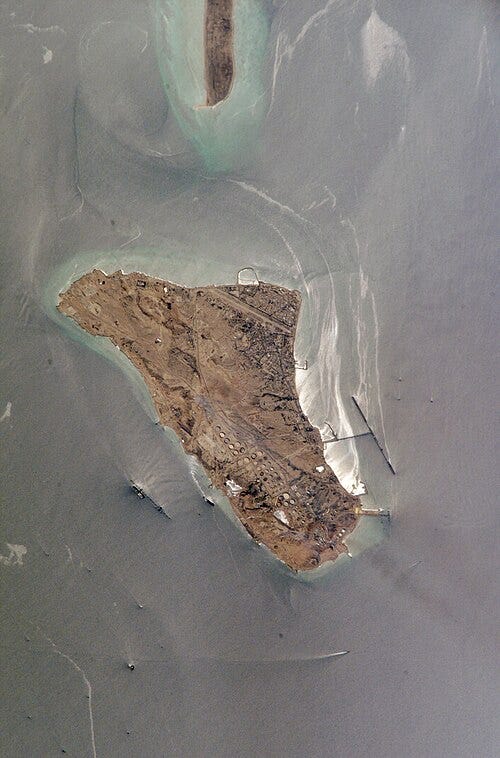

Despite the scale of the attack, both U.S. and Iranian reporting emphasized that Kharg’s oil export infrastructure was not targeted. This distinction is strategically important. Kharg Island handles approximately 90 percent of Iran’s crude oil exports, making it one of the most sensitive energy nodes in the entire Middle East. President Donald Trump indicated that the decision to avoid oil facilities was deliberate, suggesting that Washington does not currently intend to cross the threshold of directly destroying Iran’s oil export capacity. Instead, the strike appears designed to weaken Iran’s military capabilities while avoiding an immediate shock to global energy markets.
Even so, targeting Kharg - an island that functions as both a military base and Iran’s primary oil export terminal - signals a notable expansion of the battlefield. Kharg lies roughly 35 kilometers off Iran’s northern Gulf coast and plays a central role not only in oil exports but also in maritime logistics and naval operations. Striking military facilities there demonstrates that the United States is prepared to challenge Iran’s strategic position along the coastline surrounding the Strait of Hormuz, a maritime chokepoint through which roughly one-fifth of global oil supply passes. Even the perception that Kharg could become more directly involved in the conflict could influence global oil markets when trading resumes.
The Kharg strike is unfolding alongside reports that the United States may consider deploying ground forces into Iranian territory, either to seize Kharg or other land considered strategically important or to seek to enter bombed Iranian nuclear facilities and extract uranium. It is hard to know precisely how seriously to take this speculation. Reports indicate that the U.S. is sending additional forces to the region, including thousands of Marines and an amphibious assault group centered around the USS Tripoli. Amphibious task groups typically include ships capable of transporting helicopters, landing craft, and expeditionary forces capable of landing troops along coastlines or on islands.
However, these U.S. land forces and the USS Tripoli amphibious naval group have not yet arrived in the region. While Washington has announced that these forces are being deployed, there is a significant difference between announcing deployments and actually arriving, staging, and becoming operational in the theater. Moreover, it remains unclear which countries in the region would be willing to host forces that could be used in a territorial invasion under the current circumstances, given the political and security risks involved. This uncertainty suggests that the operational timeline for any expanded U.S. ground presence may be longer and more complicated than official announcements imply.
In parallel with these military moves, the United States has implored countries to form a broader international coalition to secure shipping through the Strait of Hormuz. President Trump publicly called on China, France, Japan, South Korea, and the United Kingdom to deploy naval forces to ensure freedom of navigation. Initial responses, however, suggest that many governments are approaching the request cautiously. Several states have emphasized consultations and independent decision-making rather than committing ships immediately. France has indicated that its naval forces will remain in the Mediterranean, while Japanese officials have signaled that any deployment decision requires further evaluation. This cautious response highlights the difficulty Washington faces in transforming the current conflict into a broad multinational maritime mission despite the global importance of Gulf energy flows.
Iran, for its part, appears to be implementing a strategy of reciprocal retaliation. Iranian officials have signaled that attacks on Iranian infrastructure will be answered with similar actions elsewhere in the region. After Israeli and U.S. strikes reportedly targeted a bank inside Iran, Iranian forces responded by striking a bank in the United Arab Emirates, demonstrating Tehran’s willingness to mirror attacks on financial infrastructure.
Following the attack on Kharg, Iran also issued evacuation warnings for several major UAE ports, including Abu Dhabi, Dubai, and Fujairah, warning that facilities connected to U.S. operations or logistics could become targets. Iranian officials have stated that if Iran’s energy infrastructure is attacked, Tehran will respond by targeting energy infrastructure belonging to companies associated with the United States in the region. These warnings suggest that Iran intends to expand the economic costs of the war beyond its own territory by threatening infrastructure that supports Western military operations and global energy markets.
Another important development involves damage to key U.S. aviation assets in the region. Reports indicate that five U.S. aerial refueling aircraft were damaged during an Iranian missile strike on Prince Sultan Air Base in Saudi Arabia. This adds to the refueling aircraft that crashed in western Iraq on March 12, killing six crewmembers, and a separate refueling aircraft that was damaged and forced to make an emergency landing in Israel. Taken together, seven damaged or destroyed refueling aircraft represent a significant operational challenge for U.S. air operations. Aerial refueling tankers are essential to sustaining long-range air missions, enabling fighter aircraft, bombers, and surveillance platforms to remain airborne for extended periods and operate far from their bases. While CENTCOM suggests the aircraft in Saudi Arabia were only damaged and are reportedly undergoing repairs, the incident highlights Iran’s ability to strike high-value logistical assets that could complicate the tempo of sustained U.S. air campaigns in the region.
The battlefield itself continues to evolve over the broader region. Iranian missiles and drones have been intercepted in Saudi Arabia, the United Arab Emirates, Bahrain, Kuwait, and Jordan, as regional governments activate air defense systems to counter incoming attacks. In one notable incident, a fire broke out at the Fujairah port in the UAE, one of the region’s most important oil storage and refueling hubs, after debris from intercepted drones reportedly fell near the facility. Although casualties were limited, the incident temporarily disrupted fuel-loading operations, illustrating the vulnerability of critical energy infrastructure throughout the Gulf.
Meanwhile, Iranian missile attacks on Israel continue. Israeli authorities reported multiple waves of missile strikes, including five separate waves within a nine-hour period. Israel’s health ministry stated that 108 individuals were hospitalized within the past 24 hours, most with minor injuries. Since the start of the war, Israeli officials report that 3,195 people have received hospital treatment for war-related injuries, although the government has not publicly released a comprehensive wartime death toll. Wartime censorship and reporting restrictions also limit the extent to which imagery and documentation from strike sites are publicly available, meaning that the full scale of damage inside Israel may not be visible in real time.
Alongside the regional military escalation, internal tensions inside Iran may also be rising. Some opposition figures outside the country have signaled that they may attempt to encourage domestic unrest during the ongoing war. In particular, Reza Pahlavi and Saeed Ghaseminejad, one of the former crown prince’s closest advisers, have recently issued statements that some observers interpret as encouraging anti-government cells within the country to attack Iranian police and Basij forces in the streets.
Charshanbe Suri, the traditional Iranian fire festival held on the Tuesday evening before Norooz, is just a few days away and could emerge as a flash point of societal tensions. Iranian authorities have already banned fire-related celebrations this year, citing security concerns and the need to preserve emergency resources during wartime. Police and security forces appear to be on heightened alert, reflecting concerns that the holiday could be used as an opportunity for anti-government demonstrations at a time when the country is already under external military pressure.
The war is playing out in numerous spaces involving regional military operations, maritime security, energy infrastructure, and internal political tensions. The United States is expanding military deployments while maintaining certain escalation thresholds—most notably the deliberate decision not to target Iran’s oil export facilities. Iran, meanwhile, is responding through reciprocal strikes across the region and leveraging its geographic position along the Persian Gulf to exert pressure on maritime routes and regional infrastructure.
As the war enters its third week, the interaction between military escalation, global energy security, and domestic political dynamics inside Iran may become increasingly consequential. Even limited tactical actions—whether involving maritime operations in the Strait of Hormuz, retaliatory strikes on regional infrastructure, or internal unrest—could have significant implications not only for the Middle East but also for the stability of global energy markets and the broader international economy.