

The ongoing war that began on February 28, 2026 (9 Esfand 1404) with U.S. and Israeli airstrikes on political, military, and nuclear targets across Iran has rapidly extended beyond military confrontation, placing severe pressure on Iran’s already fragile economy and the daily lives of millions of civilians. Even before the conflict began, Iran’s economy was struggling with chronic stagflation, high unemployment, and extreme inflation in food and consumer goods, with some basic items already experiencing price increases of over 90 percent. The escalation of military operations, combined with infrastructure damage, internet shutdowns, and declining economic activity has significantly intensified these pressures.
In Tehran, field reports describe a city undergoing a dramatic transformation. According to a report published by the Coordination Council of Iranian Teachers’ Trade Associations, ten days after the start of the war the capital has fallen into what observers describe as an unsettling silence. Streets that once remained busy late into the night are now largely empty, many shops are closed, and economic activity has slowed dramatically. Residents describe an atmosphere increasingly dominated by military checkpoints, armed patrols, and a heavy security presence, creating what many perceive as a city operating under a wartime security environment. The report portrays citizens caught between the fear of aerial attacks and the psychological strain of heightened security measures, while daily economic life has slowed to a crawl.
One of the most immediate consequences of the conflict has been the rapid rise in the price of essential food items. Field reports indicate that prices of basic staples such as eggs and potatoes have doubled or even tripled within the first ten days of the war. Even moderate increases in staple food prices have compounded the hardship of households already struggling with inflation. For instance, the price of a tray of eggs increased from approximately 280,000 toman to around 340,000 toman, while chicken leg prices rose from about 195,000 toman per kilogram to roughly 230,000 toman. Vegetables such as tomatoes and cucumbers have also become noticeably more expensive. These increases come on top of already severe inflation, making it increasingly difficult for many families to afford even the most basic meals. Observers describe the emotional strain experienced by parents who must navigate the anxiety of war while struggling to provide food for their families.
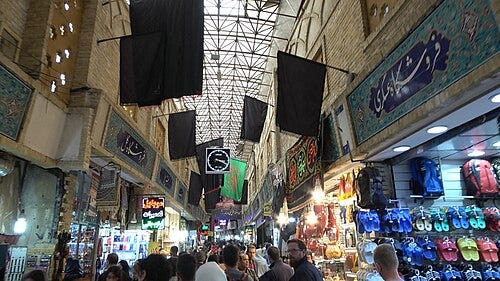
The conflict has also sharply disrupted commercial activity across the country. Tehran’s Grand Bazaar—historically the economic heart of the capital—has been partially closed, with some sections completely shut down. Many shop owners report suspending operations due to fear of further military strikes, declining demand, supply disruptions, and uncertainty about future conditions. As a result, daily sales in parts of the bazaar have reportedly fallen by between 50 and 70 percent, reflecting a significant contraction in economic activity. Across urban areas, consumer demand has dropped sharply, as many households now focus exclusively on purchasing essential goods while postponing all other spending due to uncertainty about income and the future.
Energy infrastructure has also come under pressure. On March 6 (16 Esfand), several fuel storage facilities near Tehran were struck during military operations, including oil depots in the Kouhak and Shahran districts and a storage facility in Karaj. Explosions were also reported near the Shahr-e Rey refinery complex. These incidents triggered widespread concerns about fuel shortages. Long lines formed at gas stations across the capital within hours of the reports, as residents rushed to secure fuel. Some citizens reported the emergence of a temporary black market for gasoline, where fuel was sold in containers for up to three times the official price. While authorities later stated that fuel distribution remained stable, the attacks reduced regional storage capacity and placed additional pressure on an already strained distribution network. In Tehran and the neighboring Alborz province alone, daily consumption reaches approximately 22 million liters of gasoline and 12 to 18 million liters of diesel, meaning that the fuel distribution system must transport between 34 and 40 million liters of petroleum products every day to maintain supply.
Another major shock to the economy has come from one of the longest internet disruptions in Iran in recent years. Monitoring organizations report that nationwide restrictions have lasted for more than a week, severely limiting access to international internet services. These disruptions have had a profound impact on Iran’s digital economy. Many online businesses, startups, freelancers, and service providers rely heavily on stable internet access to operate. Previous internet shutdowns earlier in 2025 had already caused major economic losses. During a roughly twenty-day disruption earlier in the year, nearly 80 percent of ATMs temporarily stopped functioning and thousands of online jobs were effectively halted. The current shutdown is once again undermining digital commerce, payment systems, and online services.
The disruption has also affected transportation services. Iran’s major ride-hailing platforms rely on GPS and mapping systems to function. With internet services disrupted, drivers and passengers report that these services operate only partially, reducing income for hundreds of thousands of drivers. Reports indicate that demand for workers in small companies has fallen by as much as 74 percent in recent weeks, reflecting the broader slowdown across many sectors of the economy.
Although major cities still report relatively stable access to protein products such as meat, poultry, and dairy, producers warn that the agricultural sector may soon face growing difficulties. Farmers and poultry producers report concerns about shortages of livestock feed, declining demand, and logistical disruptions. Some producers warn that if the war continues for an extended period, domestic meat and poultry production could face significant challenges, potentially leading to shortages and further price increases.
Conditions also vary significantly across different regions of the country. While Tehran and other large cities still maintain relatively stable supplies of essential goods, residents in some smaller provinces report more difficult conditions. In Bushehr and Hormozgan provinces, for example, residents describe longer lines at bakeries and greater difficulty obtaining some essential items. In response, the government has reportedly introduced temporary purchasing limits in some supermarkets, restricting the quantity of items such as bottled water, cooking oil, canned food, and other essential goods that consumers can buy.
The war has also increased pressure on the healthcare sector and on the psychological well-being of the population. Residents report that prices for supplements, sedatives, and psychiatric medications have increased by more than 30 percent, driven by rising demand as anxiety and sleep disorders spread among the population. Children are reportedly among those most psychologically affected, with many experiencing fear and distress during nighttime airstrikes.
Humanitarian organizations warn that the situation could worsen if the war continues. The International Federation of the Red Cross and Red Crescent Societies has reported that humanitarian needs inside Iran are increasing rapidly and has requested more than $50 million in emergency funding to support relief operations over the next sixteen months. The organization estimates that approximately five million people may require assistance, including healthcare, shelter, water and sanitation and psychological support. Across the country, more than 2,100 emergency response teams and over 6,500 Red Crescent staff and volunteers are currently engaged in search-and-rescue operations and humanitarian support.
Despite the many pressures, some markets appear relatively stable for the moment. However, economists caution that this stability largely reflects a sharp drop in consumer demand rather than genuine economic resilience. Many households are delaying purchases and conserving resources while waiting to see how the conflict evolves. Experts warn that the most severe economic consequences may emerge after the conflict ends. If consumer demand suddenly returns while production and supply chains remain weakened, the country could face another wave of inflation, shortages, and economic instability.
In this environment, the war has transformed Iran’s existing economic crisis into a broader humanitarian challenge. Rising food prices, damaged infrastructure, disrupted fuel distribution, prolonged internet shutdowns, declining employment opportunities, and growing psychological stress are collectively placing immense pressure on ordinary citizens. As the conflict continues, the economic and social costs of the war are increasingly being borne not by military actors, but by millions of civilians struggling to maintain daily life under conditions of uncertainty and hardship.