

Iran has replaced the secretary of its Supreme National Security Council, installing former Revolutionary Guard commander Mohsen Rezai in one of the country’s most important national security positions. President Masoud Pezeshkian appointed Rezai following the resignation of Mohammad Bagher Zolghadr, while Supreme Leader Mojtaba Khamenei separately named Rezai as one of his representatives on the council and appointed Zolghadr as his political adviser. Zolghadr had held the secretary position since March 2026, when he replaced Ali Larijani, who was killed in an Israeli strike.
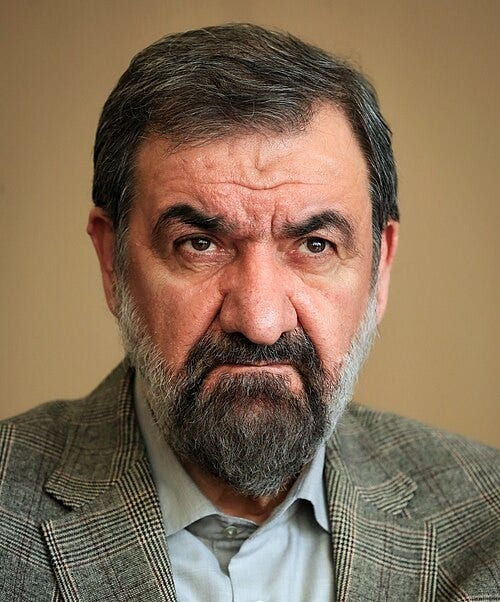

The reshuffle represents a political victory for hardline factions that had increasingly attacked Zolghadr and criticized the direction of Iran’s postwar diplomacy. But Rezai’s appointment is also taking place alongside a broader reorganization of Iran’s military and security leadership following the war, making the change potentially more significant than an isolated personnel move at the security council. Whether that broader reshuffle will translate into a fundamental change in Iran’s negotiating strategy, however, remains unclear.
The timing of the change has inevitably raised questions about whether Zolghadr’s departure was connected to disagreements over negotiations with the United States and the arrangements developed after the war. In recent weeks, political figures and media associated with the more uncompromising conservative camp had increasingly criticized Zolghadr and the direction of the Supreme National Security Council. Some of these attacks were also part of a broader struggle over the diplomatic course associated with President Pezeshkian and Parliament Speaker Mohammad Bagher Ghalibaf, who has played a central role in Iran’s negotiations over the war.
Those factions were quick to claim Rezai’s appointment as a victory. Amirhossein Sabeti, a parliamentarian close to the Paydari Front, alleged that Pezeshkian had resisted replacing Zolghadr with Rezai and celebrated the eventual appointment as “Ali al-osul 2,” referring to Mojtaba Khamenei’s earlier statement that he had “in principle” disagreed with the path taken by the Supreme National Security Council on the Memorandum of Understanding. Sabeti interpreted the appointment as confirmation that the previous course had been wrong and called on Pezeshkian to change the government’s direction. Raja News and other hardline outlets similarly connected Zolghadr’s departure to their criticism of the diplomatic process and the Islamabad understanding.
These claims do not establish why Zolghadr resigned, but they show clearly how Rezai’s appointment is being understood and promoted by the faction that had been pushing most aggressively against the existing negotiating course. For this camp, Rezai has become a symbol of correcting a security policy they believe moved too far toward accommodation with Washington.
Rezai himself contributed to this interpretation even before his appointment. After Mojtaba Khamenei said that he had “in principle” held a different view regarding the memorandum and the course pursued by the Supreme National Security Council, Rezai offered a much more explicit interpretation: “When the Leader says that ‘in principle’ I had another view, it means that the path he had in mind was better than the path the Supreme National Security Council took.” The statement was subsequently recirculated by opponents of the agreement after Rezai’s appointment.
There were also indications before the official announcement that the change was already being discussed inside the political establishment. Mohammad Bagher Kharrazi, secretary-general of Hezbollah Iran and brother-in-law of Massed Khamenei, publicly predicted several days before the appointment that Zolghadr would leave the Supreme National Security Council and Rezai would replace him. Kharrazi also claimed that Mojtaba Khamenei’s political instincts were considerably more hardline than those of his father. The accuracy of his specific prediction suggests that he had at least some knowledge of the personnel discussions underway inside the establishment, although his broader characterization of the new supreme leader remains his own assessment.
The struggle over Zolghadr has also intersected with a broader factional conflict surrounding Ghalibaf and the negotiating process. Hardline critics have increasingly portrayed the security council under Zolghadr as too accommodating of the diplomatic approach associated with Pezeshkian and Ghalibaf. There is not enough public evidence, however, to conclude that Zolghadr was simply Ghalibaf’s ally or representative inside the council. Zolghadr is himself a longtime Revolutionary Guard commander with deep roots in the conservative security establishment.
Rezai’s own history further complicates any interpretation of his appointment as a straightforward move against Ghalibaf. Ghalibaf rose through the Revolutionary Guards during Rezai’s sixteen-year tenure as commander-in-chief. During the Iran-Iraq war, Ghalibaf commanded the IRGC’s 5th Nasr Division while Rezai headed the Guard as a whole. The two therefore belong to the same generation of wartime commanders who later moved into the highest levels of the Islamic Republic.
Their subsequent political careers have not always been aligned, and they later competed against one another in presidential politics. But they are not products of opposing security networks. Their relationship goes back to the war, when Ghalibaf was one of the senior commanders serving under an IRGC led by Rezai.
Ghalibaf’s immediate reaction is notable in this context. He welcomed Rezai’s appointment, saying Iran was in “one of the most sensitive moments in its history” and emphasizing the confidence placed in Rezai’s military and managerial experience. This does not establish a current political alliance between them, but there is also little public indication so far that Ghalibaf regards Rezai’s arrival as a direct challenge to his position.
The backgrounds of Rezai and Zolghadr also make a simple moderate-versus-hardliner interpretation difficult. Both emerged from the same generation of revolutionary security figures, both were associated before the revolution with the Islamist militant organization Mansouroun, and both subsequently became important figures in the Revolutionary Guards and the Islamic Republic’s security establishment.
Zolghadr therefore cannot reasonably be described as a moderate displaced by a hardliner. Only one day before leaving the council, he declared that the Strait of Hormuz would not reopen unless the United States changed its behavior and accepted Iran’s demands, including ending military operations, lifting the naval blockade and sanctions, paying compensation and releasing blocked Iranian assets. He also insisted that the Supreme National Security Council would retreat neither in war nor in negotiations.
Iranian political analyst Ahmad Zeidabadi has pointed to this contradiction. Zolghadr had traditionally been identified with the harder-line conservative establishment, while Rezai had at times appeared comparatively more pragmatic. Their positions during the recent crisis, however, complicated those older classifications. Following the reshuffle, Zeidabadi argued that, considering the backgrounds and recent positions of the two men, understanding the precise meaning of the replacement from the outside is “if not impossible, extremely difficult.”
Rezai has nevertheless been considerably more outspoken in criticizing the recent diplomatic course. During the postwar period, he repeatedly argued that Iran could not indefinitely pursue negotiations while remaining under military pressure and warned that Tehran could move from retaliation toward a more offensive military posture. His interpretation of Mojtaba Khamenei’s “Ali al-osul” statement also placed him publicly alongside those arguing that the Supreme National Security Council had followed the wrong path. His appointment therefore may give critics of the recent negotiating course a much stronger institutional voice, even if it does not yet prove that their preferred strategy has become government policy.
Rezai also carries unusual institutional weight. He became commander of the Revolutionary Guards at 27 and remained in the position for sixteen years, overseeing almost the entire Iran-Iraq war and a critical period in the IRGC’s transformation into a major military and political institution. He subsequently spent roughly twenty-four years as secretary of the Expediency Council and later served as economic vice president under Ebrahim Raisi. His return puts one of the Islamic Republic’s most experienced military-political figures back at the center of day-to-day national-security decision-making.
Rezai’s appointment also comes amid a broader reorganization of Iran’s postwar military and security command. In a series of new decrees, Mojtaba Khamenei appointed Ali Abdollahi as chief of the Armed Forces General Staff, replacing Abdolrahim Mousavi, who was killed in U.S. and Israeli attacks. The decree specifically called for completing the integration of the Armed Forces General Staff and Khatam al-Anbiya Central Headquarters. Keyomars Heydari was appointed deputy chief of the General Staff, while Ahmad Vahidi received a new decree as IRGC commander and Mostafa Izadi was appointed his deputy. Former IRGC intelligence chief Hossein Taeb was also returned to the leadership of the Basij, replacing Gholamreza Soleimani, who was killed during the war.
Taken together with Rezai’s appointment, the changes suggest that Khamenei is moving relatively quickly to rebuild and consolidate the military-security command after the losses suffered during the war. The reliance on veteran figures such as Rezai, Vahidi and Taeb also points toward a renewed role for experienced members of the Islamic Republic’s older security establishment at the expense of the next generation of security figures.
The meeting between Pezeshkian and Supreme Leader Khamenei also points to continued involvement for the President in high-level security decisionmaking. Pezeshkian says his latest meeting with Mojtaba Khamenei lasted approximately seven hours, with discussions covering living conditions, employment, housing, sanctions, how the government and public should respond to external pressure and the preservation of national unity. According to Pezeshkian, Khamenei particularly emphasized maintaining “unity and cohesion” and warned against efforts to create internal divisions.
The timing of the disclosure is particularly notable. Details of the lengthy meeting emerged alongside the changes at the Supreme National Security Council and the broader reshuffling of Iran’s military-security leadership. While neither Pezeshkian nor Khamenei’s office has said that the appointments were discussed, the timing suggests that major personnel and security decisions were among the issues addressed during such an extensive meeting. The public disclosure of the meeting may also be intended to signal that the president and the new supreme leader are coordinating, and that the changes should not necessarily be interpreted as having been imposed on Pezeshkian against his will.
That possibility is particularly relevant to Rezai’s appointment because the change formally required actions from both sides of the political system: Khamenei appointed Rezai as his representative on the Supreme National Security Council, while Pezeshkian appointed him secretary of the council following Zolghadr’s resignation. The simultaneous emphasis on the Khamenei-Pezeshkian meeting therefore presents the reshuffle publicly as a coordinated transition between the presidency and the new leadership, even as hardline factions are portraying Zolghadr’s departure as their own political victory.
Pezeshkian had previously said that his first meeting with the new leader on May 6 lasted roughly two and a half hours. The latest meeting lasted nearly three times as long, suggesting that despite apparent disagreements over the negotiating course and pressure from hardline factions, Pezeshkian remains directly involved in extensive discussions with Khamenei over the country’s direction.
The meeting also carries extra significance because Mojtaba Khamenei has yet to appear publicly or release an audio or video message since becoming supreme leader. Pezeshkian remains the only senior official to have publicly described an in-person meeting with him and specifically said after the latest meeting that Khamenei was in “complete physical health.”
Rezai’s appointment, together with the wider military reshuffle, demonstrates a significant reorganization of Iran’s postwar security establishment and a likely shift in the internal balance surrounding its strategy. Hardline factions that had attacked Zolghadr and the direction of negotiations have gained ground, while Khamenei is simultaneously rebuilding the military command around experienced figures from the Islamic Republic’s security establishment.
The real indication of a strategic shift will be what happens next: whether negotiations continue, whether Iran changes its conditions surrounding the Strait of Hormuz and a broader agreement, and whether Ghalibaf retains his central role in the diplomatic process. If those elements remain largely intact, the reshuffle may ultimately represent an effort by the new supreme leader to consolidate the postwar security establishment and accommodate hardline pressure while preserving room for negotiations. If the negotiating framework changes substantially or the roles of Pezeshkian and Ghalibaf are reduced, the appointments will look increasingly like the institutional foundation of a broader change of course.