

A week ago, Iranian officials were signaling meaningful progress toward an arrangement with Oman over shipping through the Strait of Hormuz, potentially removing one of the major obstacles to reviving the June agreement that briefly halted the Iran-U.S. war. Since then, however, there has been no announcement of a final Oman agreement. Iran says it is not engaged in formal negotiations with the United States, and an Iranian official told Reuters this week that there are no talks underway to extend the 60-day period envisioned in the June Islamabad Memorandum of Understanding, which expires Sunday.

But the diplomatic channel has not disappeared. Iranian officials acknowledge that messages are still being exchanged with Washington through intermediaries. Pakistan, which brokered the June agreement, has continued its mediation efforts. And Iran’s new national security chief has made clear that Tehran still sees diplomacy as part of its strategy, while drawing a sharper line between an agreement over shipping through the Strait of Hormuz and a broader settlement with the United States.
Tehran appears to be keeping the door to a deal open while trying to demonstrate that it is content to wait for Washington to concede on key terms. Pakistan’s Interior Minister Mohsin Naqvi traveled to Tehran this week and met President Masoud Pezeshkian, Foreign Minister Abbas Araghchi and newly appointed Supreme National Security Council Secretary Mohsen Rezai. Pakistan’s Foreign Ministry described the trip as part of its continuing effort to de-escalate the conflict and bring Iran and the United States back to negotiations.
On Friday, Pakistani Foreign Minister Ishaq Dar went further, telling the U.S. chargé d’affaires in Islamabad that the “faithful and complete implementation” of the Islamabad memorandum, in both letter and spirit, remained the “only way forward” toward a durable peace between Iran and the United States. Continued Pakistani mediation cuts against the idea that recent personnel changes in Tehran have shut down the diplomatic track. Rezai’s return to the Supreme National Security Council had raised questions about whether Iran might be moving toward a harder line. A former longtime commander of the Islamic Revolutionary Guard Corps, Rezai replaced Mohammad Bagher Zolghadr amid a broader reshuffling of Iran’s military and security leadership.
But Rezai’s first substantive comments on the negotiations suggest something more complicated than a rejection of diplomacy. Meeting China’s ambassador in Tehran this week, he said that even if Iran and Oman reach an agreement over a new route for ships passing through the Strait of Hormuz, that arrangement would be separate from the question of reopening the strait itself. Rezai said Hormuz would remain closed until Washington changed its behavior and accepted broader Iranian conditions, including ending the war and releasing frozen Iranian funds. He also linked the issue to an end to the wars in Lebanon and Gaza and said additional Iranian conditions had been conveyed to Washington through intermediaries.
That clarification may help explain what happened to the apparent breakthrough with Oman. The negotiations with Muscat were never necessarily negotiations to restore the Strait of Hormuz to its prewar status. Iranian and Omani officials had been discussing a more limited arrangement: establishing a navigable corridor and rules for commercial shipping while addressing what Tehran describes as its security and sovereign concerns.
Tehran appears to be treating these as connected but separate tracks: negotiations with Oman over shipping, indirect exchanges with Washington through intermediaries, implementation of the Islamabad memorandum and, ultimately, formal negotiations over ending the war. Araghchi has made a similar distinction. He says there are currently no formal negotiations between Iran and the United States, but has acknowledged that messages continue to move between the two sides through mediators. He has also said that restoring security in the Strait of Hormuz requires an end to U.S. military attacks and Washington’s naval blockade.
At the same time, statements from Iran’s military establishment increasingly suggest that Tehran wants Washington to believe it has another option: enduring continued warfare. The clearest example came in an unusually candid interview this week with Mohammad Reza Naqdi, a senior adviser to the commander of the Revolutionary Guard. Speaking to PBS NewsHour in Tehran, Naqdi argued that Washington had failed to achieve what he characterized as its original objectives in the war and suggested that Iran could deliberately prolong the conflict to impose sustained costs on the United States. Asked about continuing the war through the remainder of Donald Trump’s presidency, Naqdi described attrition as one possible strategy.
Naqdi also claimed that Iran is producing more missiles than it is firing and therefore has the capacity to sustain military operations for years. That claim cannot be independently verified. But the course of the war has provided indications that Iran’s strike capabilities have continued to evolve rather than simply erode under sustained military pressure. Iranian attacks have appeared increasingly accurate and destructive over time, most notably in strikes on U.S. positions in Jordan that killed several American service members and surprised some military observers. The apparent improvement prompted speculation that Iran may have received specialized technology or equipment from China or Russia, though there is no conclusive public evidence establishing such assistance.
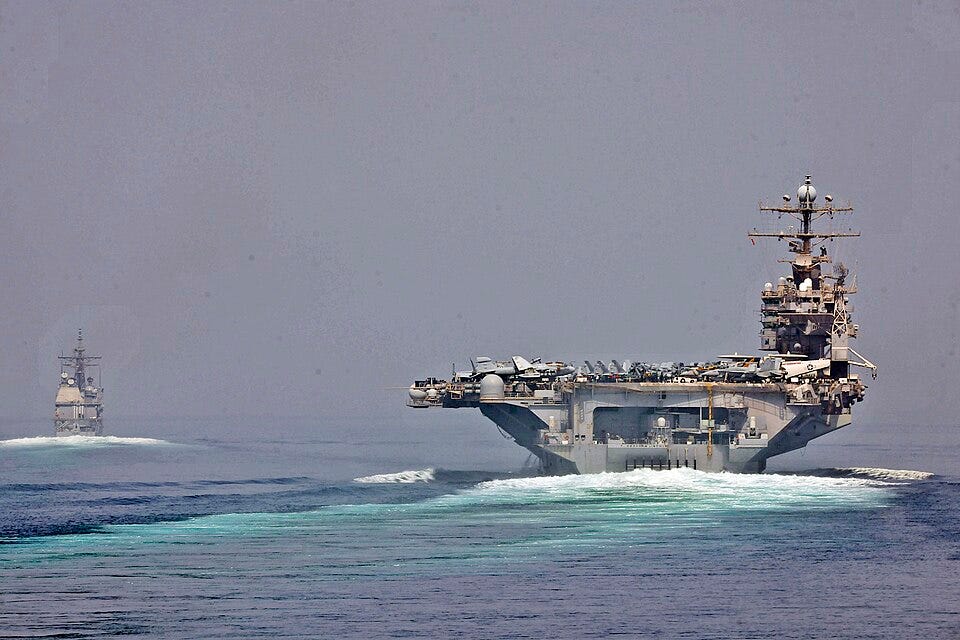
That perception is developing alongside a different problem for Washington: the strain that months of fighting have placed on both military personnel and stocks of expensive precision weapons, including air-defense interceptors and long-range stand-off munitions. Recent reports have indicated exceptionally low morale on board the USS Abraham Lincoln, which is a key part of the naval force implementing the blockade against Iranian vessels entering and exiting the Persian Gulf. Moreover, Iran’s ability to replenish and adapt its comparatively cheaper missile and drone arsenal, set against the cost and availability of the precision weapons required to intercept or strike them, has therefore become an increasingly important part of the war’s longer-term calculus. None of this proves Naqdi’s claim that Iran can sustain operations for years, but it complicates the assumption that time and attrition necessarily favor the United States.
In separate remarks to Iranian media, Naqdi said Iran had decided to move from a defensive military doctrine toward a more “offensive” one based on “hybrid warfare,” in which military power operates alongside diplomacy, economic policy, information operations and other instruments of national power.
Other figures have made similar remarks. Alireza Sheikh, the executive deputy of Iran’s regular army, similarly said this week that the country is prepared for a “long battle” and has built the capacity to sustain prolonged military operations, pointing specifically to domestic missile and drone production. Other senior military officials have warned that Iran would respond more aggressively in another round of fighting.
Taken together, these statements do not prove that Iran actually possesses the economic or military capacity to fight indefinitely. But they do reveal a relatively consistent message coming from Iran’s security establishment: Tehran wants Washington to believe that time is not necessarily on America’s side.
That calculation increasingly extends beyond the direct Iran-U.S. confrontation. In Yemen, the Houthis have resumed attacks amid the breakdown of their ceasefire with the Saudi-backed government, including claiming a drone strike this week on an Aramco facility in Jizan. Attacks around Bab al-Mandab have again threatened commercial shipping, while tensions between the Houthis and Saudi Arabia have risen sharply. In Lebanon, Israeli military operations in the south have continued as efforts to reach a broader settlement remain unresolved.
Iranian officials are increasingly connecting these fronts politically. Rezai’s demand for an end to the wars in Lebanon and Gaza as part of Iran’s conditions for fully reopening the Strait of Hormuz is one example. Pezeshkian has also faced calls from Japan to use Iran’s influence to reduce tensions around Bab al-Mandab while negotiations over Hormuz continue.
This does not mean Tehran controls the decisions of the Houthis or other armed groups across the region, or that every regional escalation is directed by Iran. But from Tehran’s perspective, the war is being treated as a regional strategic contest rather than a series of isolated conflicts. Pressure in the Strait of Hormuz, instability around Bab al-Mandab, continued fighting in Lebanon and the U.S. blockade of Iran all affect the broader calculation over how the war might end.
The Strait of Hormuz remains the most important piece of that calculation for Iran. Iranian military officials continue to insist that the strait remains under Iranian control, directly contradicting President Trump’s repeated claims that the U.S. Navy now exercises “complete control” over the waterway. Iran says commercial vessels must coordinate with Iranian forces to transit safely, while the United States maintains a naval blockade of Iranian ports and says its forces have diverted dozens of vessels attempting to trade with Iran.
The reality on the water appears more complicated than either side’s sweeping claims. Commercial traffic remains far below normal levels, but some ships are still passing through the strait, with maritime tracking data indicating that many of the vessels that do transit are using routes through Iranian waters. Iraq, meanwhile, has been forced to develop alternative export routes after disruption in Hormuz sharply reduced its ability to move crude through its traditional Gulf terminals.
The result is an unusual standoff in which Washington and Tehran both claim control over the same strategic waterway while neither side has been able to restore normal commercial traffic. For Tehran, that may strengthen the argument against moving first. Iranian officials argue that the United States violated the June Islamabad agreement shortly after it was reached and subsequently restored military and economic pressure. From Tehran’s perspective, reopening the Strait of Hormuz without receiving reciprocal concessions would mean giving away one of the few tools that has imposed significant costs beyond Iran’s borders.
Washington is making the opposite calculation. U.S. officials argue that the naval blockade and mounting economic pressure will eventually force Tehran to compromise. Defense Secretary Pete Hegseth said this week that the U.S. Navy can maintain the blockade indefinitely, while Treasury Secretary Scott Bessent has promised additional measures aimed at further isolating Iran economically.
The two sides are therefore not simply divided over the terms of a possible agreement. They are increasingly testing which side has the greater capacity — and political willingness — to endure the current situation.
Whether Iran can actually afford such patience is a different question. The country is facing severe economic pressure, infrastructure damage, growing strains on fuel supplies and mounting costs from the U.S. blockade. A prolonged conflict would place an enormous additional burden on ordinary Iranians. But negotiations are shaped not only by a country’s actual ability to withstand pressure. They are also shaped by what each side believes about the other’s ability and willingness to endure it. For now, Tehran appears intent on sending Washington a message: Iran is willing to outwait the United States.