

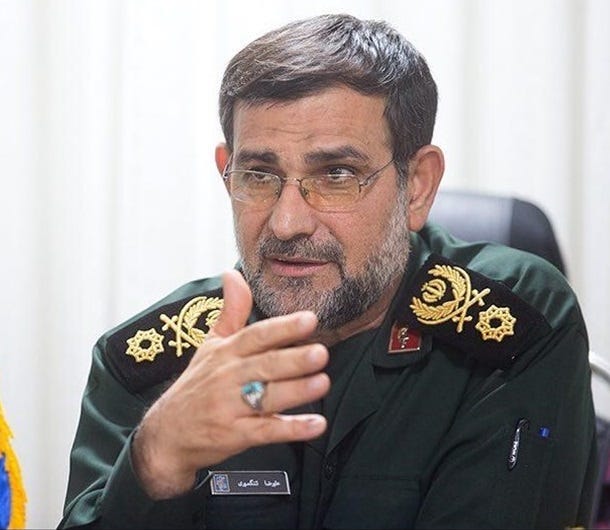
As the U.S.-Israel war continues, Iran faces broad systemic pressure, combining leadership decapitation, industrial disruption, civilian casualties, and economic coercion. While the reported killing of IRGC Navy commander Alireza Tangsiri remains a significant development, particularly given his central role in Iran’s maritime strategy and enforcement around the Strait of Hormuz, the killing of any decisionmakers is unlikely to have a significant impact on the direction of the war.

One of the most important new developments is the expansion of strikes to critical industrial infrastructure inside Iran. Air attacks targeting Mobarakeh Steel in Isfahan and Khuzestan Steel signal a shift toward economic warfare aimed at weakening Iran’s production capacity and long-term resilience. Initial reports indicate that parts of these facilities were damaged, with at least one fatality and two injuries confirmed in Isfahan, while damage assessments in Khuzestan are ongoing. In parallel, the Firouzabad cement mine—a civilian industrial site—was struck, resulting in two workers killed and two injured. These attacks demonstrate a widening target set that now includes labor-intensive industries and economic infrastructure. Iran has vowed to retaliate harshly, indicating that a number of steel facilities in both Israel and Gulf monarchies will soon be subject to retaliation.
The civilian toll continues to rise sharply. In the latest wave of strikes, 18 people were killed and 10 wounded in Pardisan, Qom, while 10 others were killed in a residential attack in Shahr-e Rey. Images from Tehran show rescue teams searching through rubble in heavily damaged residential buildings. These incidents highlight a growing pattern in which urban areas are increasingly becoming direct zones of impact and the distinction between military and civilian spaces is eroded. Compounding this is the limited flow of information from inside Iran, due to internet disruptions and restricted access for international media, making it difficult to fully assess the scale of the humanitarian impact.
Despite these escalating pressures, including the loss of senior figures such as Tangsiri, Iran continues to demonstrate strategic continuity. There are no clear signs of breakdown in command or coordination. Instead, Iran has maintained a consistent posture across multiple domains. In the maritime sphere, the IRGC announced that three vessels attempting to pass through the Strait of Hormuz were turned back, reiterating a policy of selective closure—open to certain countries with coordination, but effectively restricted for adversaries. This reflects a broader message that the system remains operational, capable of enforcing policy, and willing to escalate when necessary.
At the regional and economic level, the war is producing ripple effects beyond Iran’s borders. Reports of drone strikes on key infrastructure such as Kuwait’s Shuwaikh port indicate that the conflict is increasingly targeting critical trade nodes, even when casualties are avoided. Meanwhile, global markets are responding with sustained volatility. Despite Washington’s announcement that attacks on Iran’s energy infrastructure have been delayed by 10 days, oil prices have not stabilized, with Brent crude rising above $110 per barrel again. Earlier comments suggesting an imminent deal did not manifest, which had contributed to a brief dip in energy prices.
Alongside military escalation, diplomatic contacts continue but remain limited. Multiple channels are active, including indirect communications through regional intermediaries and reports of possible meetings involving U.S. and Iranian representatives. A 15-point proposal from Washington has been transmitted via intermediaries, while regional actors are engaging in parallel efforts to explore pathways toward de-escalation. However, the distance between the two sides remains substantial. Iran has made clear that any ceasefire must include recognition of its sovereign rights, compensation for damages, and guarantees against future attacks, alongside broader conditions related to the scope of the conflict and its strategic position. At the same time, Iranian officials have emphasized that the timing and terms of ending the war will not be dictated externally, rejecting recent proposals as unrealistic. In contrast, U.S. leadership continues to pursue a dual-track approach—delaying certain strikes while warning of severe escalation if Iran does not accept the proposed framework.
Another emerging dimension is the question of sustainability on all sides. Reports pointing to manpower strain and operational pressure within Israel suggest that the war is imposing structural burdens beyond Iran itself, raising questions about how long such a high-intensity, multi-domain conflict can be maintained without broader consequences.
Moreover, rumors in Washington suggest a possible escalation toward an invasion of Iran, potentially centered on the Persian Gulf coastline and islands in the vital waterway. While military experts have raised significant doubts about the viability and sustainability of these objectives, the possibility of escalation cannot be discounted. If pursued, it would lead to a deepening of the war and potentially trigger significant casualties on all sides.
The war is at a critical and uncertain point. There are visible efforts toward negotiation and temporary restraint, but they are occurring alongside continued escalation. The current trajectory suggests two competing dynamics unfolding simultaneously: a narrow and difficult path toward a potential ceasefire, and a growing risk of deeper escalation that could extend the war into a longer, more exhausting phase, potentially involving expanded military operations and a shift toward attritional conflict. Which of these paths ultimately prevails will depend on whether diplomatic efforts can overcome the widening gap in expectations, or whether continued pressure and mistrust push the war further into a prolonged and more destructive stage.