

The NIAC Capitol Insider is a newly launched digest tracking the latest from Congress on Iran-related policy developments, legislation, votes and more. This resource is designed to give our community a clearer, more comprehensive understanding of how Congress is approaching Iran policy by breaking down votes, providing policy analysis, and updating on key congressional actions.
Senate Prepares for Second Vote on Iran War Powers
House to Consider Two War Powers Resolutions on Iran, Lebanon
Rubio Testimony
The “United States-Israel Defense Technology Cooperation Initiative”
House Members Press for More Answers on the Minab Strike
This week in Congress will see Secretary of State Marco Rubio testify in both the Senate and House on the State Department budget, votes in the House and Senate on Iran war powers resolutions, a vote on a separate Lebanon war powers resolution, and a consequential committee showdown over an effort to more closely tie the U.S. and Israeli militaries together.
All of this follows a one-week recess and significant progress in advancing war powers resolutions. Prior to recess, the Senate cleared a key procedural hurdle to advance a War Powers Resolution aimed at limiting the administration’s military operations against Iran, while House Republicans delayed and ultimately pulled a similar vote amid signs the resolution may have had enough support to pass.
Since then, negotiations on a memorandum of understanding that would formally end the war between the United States and Iran have met newfound complications amid escalating Israeli military action in Lebanon, with Iran reportedly breaking off all informal contacts with the U.S. in response. That news has sent oil prices spiking, which may influence expected votes this week. Congress is expected to holdWar Powers votes in both chambers, ensuring continued scrutiny of the administration’s conduct during the war and its use of military force without congressional authorization.
Senate Advances War Powers Resolution
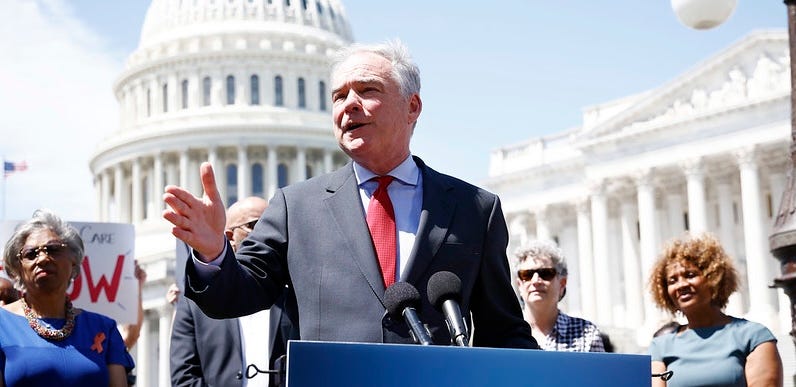
Before recess, the Senate finally advanced an Iran war powers resolution from Sen. Tim Kaine (S.J.Res.185) by narrowly voting to approve a discharge petition to bring the measure to the floor, marking a key procedural step toward limiting President Trump’s authority to continue military operations against Iran without congressional authorization.
This sets up the Senate for a second vote on a “motion to proceed” to consider the resolution, which would then set up a third vote on final passage. Timing has not been finalized as of the time of publication, but is expected for this week. If no votes change and the Senate sees full attendance, the resolution could be headed for a 50-50 tie. Under such a scenario, Vice President JD Vance would be expected to break the tie and vote the resolution down. The spectacle of the Vice President being forced to intervene to stop a Republican-majority Congress from voting to end the war would further reinforce how much of a political liability the conflict has become as lawmakers head into the midterms. Such a step could come with costs for Vance as well, further linking him to an unpopular war despite his efforts to cultivate an image as a restrainer and opponent of forever wars. However, it is possible that the vote will pass, regardless of the tiebreaker working in the administration’s favor.
On the earlier discharge petition, the Senate voted 50–47 with Republican Senators Susan Collins (ME), Lisa Murkowski (AK), Rand Paul (KY) repeating their votes for an Iran war powers resolution and Bill Cassidy (LA) joining them for the first time. All Democrats except for Sen. John Fetterman (D-PA) again voted for it. With three Republicans absent, the measure was able to move forward despite lacking a majority of the chamber.
The Republican defections were politically significant, reflecting growing concerns within the GOP over the political and economic fallout of the war, particularly soaring gas prices that have increasingly become a major liability for Republicans in their home states. Senator Bill Cassidy’s support was especially notable given that it came just days after he lost his primary race, leaving him with far less political incentive to remain aligned with party leadership or the administration’s position on the war as he no longer faces reelection pressure. After seven prior failed attempts to advance similar legislation, the successful discharge vote represented the first major procedural breakthrough for congressional opponents of the war.
House to Consider Two War Powers Resolutions on Iran, Lebanon
This week, the House of Representatives will try again to vote on an Iran war powers resolution (H.Con.Res.86) from Rep. Gregory Meeks (D-NY) as well as a separate Lebanon war powers resolution (H.Con.Res.84) from Rep. Rashida Tlaib (D-MI). After the procedural win in the Senate, the Meeks resolution was expected to receive a vote amid speculation that it had the votes to pass. But in a dramatic move, House Republican leadership abruptly canceled the vote before it could formally reach the floor.
In the prior House War Powers vote the week before, Republican Reps. Brian Fitzpatrick (PA) and Tom Barrett (MI) had already broken with leadership, marking new cracks in GOP unity. Heading into the expected next vote, additional Republican movement, combined with an anticipated “yes” from Representative Jared Golden, who had previously voted with Republicans to block earlier resolutions, would have been enough to push the measure over the threshold for passage. Representative Gregory Meeks, who introduced the measure, stated afterward: “We had the votes without question and they knew it.”
Rather than risk a public defeat, House Republican leadership indefinitely delayed consideration of the measure until lawmakers return from recess this week. Now, this week’s vote is likely in a very similar position, with passage or failure depending on how many lawmakers show up to the vote and whether opposition to the war among Republicans continues to grow.
Tlaib’s war powers resolution focuses on U.S. support in green-lighting Israel’s military operations in Lebanon, which are conducted with many U.S. munitions. Israel has been escalating its campaign there with U.S. approval, which has also led to strong objections from Iran, which has insisted that the ongoing ceasefire applies to the Lebanon theater of the war as well and that the continuation of hostilities there will threaten the entire ceasefire. While it is unlikely to pass, the vote may well represent a new high water mark in Congressional opposition to Israeli military operations in Lebanon.
Secretary of State Marco Rubio’s Testimony on Iran
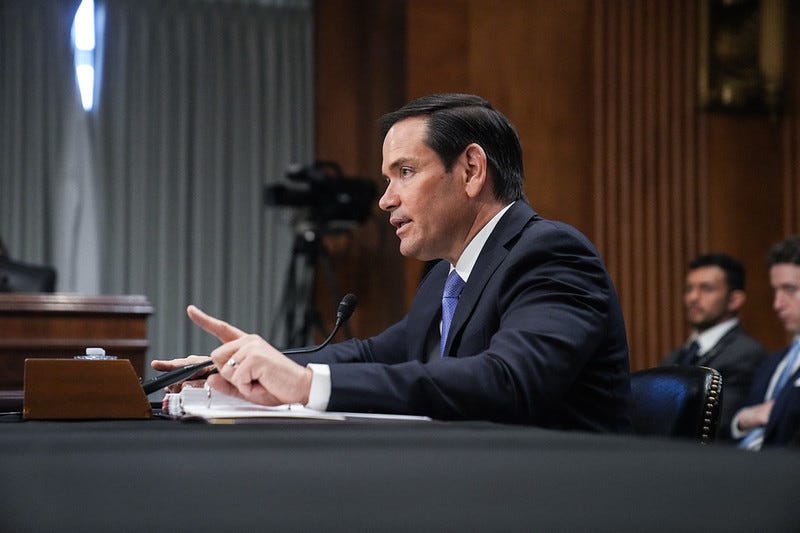
U.S. Secretary of State Marco Rubio is expected to testify on the State Department budget in the Senate Foreign Relations Committee on Tuesday, and in the House Foreign Affairs Committee on Wednesday. Following prior high profile testimony from Secretary of War Pete Hegseth, this will be yet another rare moment when a cabinet-level administration official will face Congressional questioning on the war in Iran and other topics.
Secretary Rubio is intimately involved in foreign policy given his dual-hatted role as both Secretary of State and national security advisor. A long-time hawk on Iran, Rubio has largely kept a low profile on Iran policy, with earlier negotiations being led by Special Envoy Steve Witkoff and the President’s son-in-law Jared Kushner. We expect robust questioning of the administration’s policy on Iran and hope for tough questions on the administration’s throttling of visa issuances as well.
The “United States-Israel Defense Technology Cooperation Initiative”
On Thursday, the House Armed Services Committee is set to consider the National Defense Authorization Act, which contains a controversial provision that would further enmesh the U.S. and Israeli militaries in deeply troubling ways. Sec. 224 of the bill, entitled the “United States-Israel Defense Technology Cooperation Initiative” mandates that the Pentagon “fuse the U.S. and Israeli defense sectors in multiple areas vital to the battlefields of the future.” This would be accomplished via the creation of an Executive Agent at the Pentagon who would be tasked “to expand and accelerate bilateral defense technology research, development, testing, evaluation, integration, and industrial cooperation” between the U.S. and Israel, spanning everything from artificial intelligence - which has been utilized heavily in Israel’s ongoing genocide in Gaza - to drone technology, to network integration and defense industrial base cooperation.
Such a move runs sharply counter to growing public opposition to Israeli military operations in the Middle East, U.S. support for them and concern about Israeli influence over U.S. policy. This effort to further fuse the Israeli military - accused directly of genocide - with the American military raises significant concerns over the short, medium and long term, and would likely augur very poorly for those who want to end the war in Iran and end American militarism in the Middle East and around the world. Congressional leaders have already spoken out against it, including Rep. Ro Khanna (D-CA) who has vowed to oppose it in committee and Rep. Thomas Massie (R-KY), who has vowed to oppose it if it reaches the House floor. It remains unclear whether those amendments will secure sufficient support to strip the provision from being included in the “must-pass” defense policy bill, or whether it would be included in a similar Senate version of the same package. Expect more updates on this critical development shortly.
House Members Press for More Answers on the Minab Strike
Beyond the escalating War Powers fight, House Democrats are also increasing pressure on the Pentagon and CENTCOM over the ongoing investigation into the February strike on the Minab girls’ school in Iran, which killed more than 150 civilians, including 120 young schoolchildren.
In a recent House Armed Services Committee hearing, Ranking Member Adam Smith (D-WA), alongside Representative Sara Jacobs (D-CA), who helped lead the initial congressional letter on the strike, pressed CENTCOM on the status of the investigation and the U.S. role in the incident. Jacobs specifically pressed for clarity on the broader pattern of school bombings during the war, asking CENTCOM’s Adm. Cooper how many of the reported strikes on schools in Iran involved U.S. munitions. In response, Cooper suggested that out of 39 schools bombed in Iran, only one involved U.S. munitions, the Minab strike, a statement that, if accurate, would imply that Israel was responsible for the remaining strikes.
Ranking Member Adam Smith emphasized the significance of the Minab school bombing, saying, “It’s really pretty clear what happened there,” and noting that in previous cases the U.S. military has often acknowledged mistakes even while investigations were still ongoing. He pressed further, asking: “Can you, at this moment, acknowledge that that mistake was made, and that we were responsible for it? It’s something we didn’t want to do, and don’t want to repeat?”
Cooper declined to take responsibility, responding that “The United States does not deliberately target civilians.” He added that the school is located near what he described as an “active” IRGC cruise missile base, making the incident “more complex than the average strike,” and pledged transparency once the investigation concludes.
Smith pushed back on the response, stating, “I do not trust that answer. What we’ve seen out of this Secretary of Defense (Pete Hegseth) and his callous disregard for any sort of rules of engagement or protecting civilian life may make us suspicious.”
CENTCOM officials said the investigation on the Minab strike remains ongoing but that the process is nearing its end. Representative Jacobs also pressed during questioning that the findings of the investigation would be shared with the public once completed.
Together with the War Powers debate, the Minab case has become part of a broader push in Congress for both limits on the use of force and greater accountability for civilian casualties in the war.