

A series of violent events have flared in Iran’s restive border regions as the war with the U.S. continues to play out in the Strait of Hormuz and broader Middle East. This includes a nine-hour gun battle in southeastern Iran, the assassination of a Sunni cleric close to the government in Zahedan, and separate killings of figures affiliated with the Islamic Revolutionary Guards Corps and Basij in Iran’s Kurdish northwest.
.jpg)
There is no evidence that the recent incidents in Sistan and Baluchistan and Iranian Kurdistan were coordinated with each other or directed by the United States, Israel or another outside power. Armed conflict in both regions long predates the current war and has distinct local roots. But their timing raises a consequential question: could a prolonged external war fuel Iran’s existing internal conflicts?
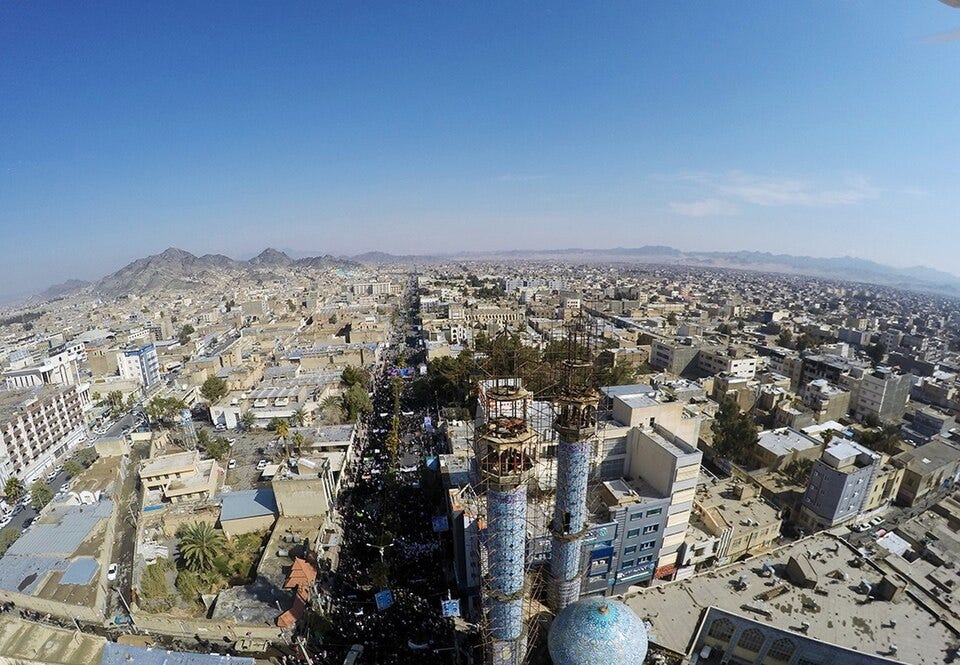
The clearest recent warning came from Saravan, near Iran’s border with Pakistan. On September 12, Iranian security forces and members of the People’s Fighters Front fought for roughly nine hours in the Bakhshan area. The Revolutionary Guards said four militants and three Iranian personnel were killed. The armed group said security forces had surrounded one of its units and that it dispatched five reinforcement teams to break the encirclement.
The competing details cannot be independently verified. But even the government’s account indicates that this was more than an isolated shooting: an organized armed group engaged Iranian forces in a prolonged battle with fatalities on both sides.
The organization itself reflects a recent change in the Baloch insurgency. The People’s Fighters Front was established in late 2025 through the merger of Jaish al-Adl and several smaller armed Baloch organizations. In announcing the new coalition, its leaders spoke not only about Baloch grievances but about broader political change in Iran and cooperation with other anti-government movements. Iranian hardline media have largely described the merger as a rebranding of Jaish al-Adl following security-force pressure, and there is not yet enough evidence to determine whether consolidation has significantly increased the militants’ capabilities.
However, the situation escalated further with the assassination of a pro-government figure. Molavi Yousef Gorgij, a Sunni cleric close to the Islamic Republic, attended the funeral of security personnel killed in the fighting and spoke publicly there. Shortly afterward, gunmen assassinated him in Zahedan.
No organization has claimed responsibility, and Iranian authorities have not produced public evidence identifying the perpetrators. The timing is striking but does not establish that Gorgij was killed in retaliation for Saravan. Other recent armed attacks in the province have included the killing of two Revolutionary Guards personnel in the Kurin area of Zahedan earlier in September.
Hundreds of miles to the northwest, a separate series of attacks has occurred in Iran’s Kurdish regions. Mullah Mohammad Nezhati, a Sunni cleric and active Basij member, was shot dead by motorcycle-riding gunmen in Piranshahr on September 8. Iranian authorities blamed Kurdish opposition groups, although no Kurdish organization initially claimed the attack. Days later, Eslam Kak Darvishi, a longtime Revolutionary Guards member who had served in Marivan, Baneh and Piranshahr, died from wounds sustained in another attack. A group calling itself Khori Hiva, or Sun of Hope, claimed responsibility for that killing.
The similarities with Baluchistan should not be overstated. Iran’s Kurdish and Baloch conflicts are not a single insurgency. Their organizations, histories and political demands differ, and there is no evidence connecting the attacks in Piranshahr to the fighting in Saravan. Peaceful Kurdish political activity and the nationwide Woman, Life, Freedom movement must also be distinguished from armed Kurdish organizations.
But Tehran’s behavior since the beginning of the current war shows that Iranian Kurdish armed groups have already become part of its wartime security calculations. Since the regional war began on February 28, Iran has repeatedly struck positions, camps and residential areas associated with Iranian Kurdish opposition organizations across the border in Iraqi Kurdistan. Targets have included factions of Komala, the Democratic Party of Iranian Kurdistan, the Kurdistan Freedom Party and the Khabat Organization. Adding to the securitization in Kurdish areas, President Trump has said that the United States sent guns intended for Iranian protesters but that Kurdish groups kept them, a claim that has been denied.
The strikes began early in the war and continued through subsequent months, including during periods when direct Iran-U.S. and Iran-Israel fighting declined. Kurdish organizations have reported multiple fatalities, although their cumulative figures cannot all be independently verified. A July strike on the Zargwezela camp near Sulaymaniyah reportedly killed ten Komala members.
A September 7 drone attack on a Komala-associated camp in Surdash was therefore part of an established wartime pattern rather than an isolated escalation. Komala said the site housed families and that the attack caused damage but no casualties.
This chronology matters. Tehran began repeatedly targeting its Kurdish opponents across the Iraqi border well before the latest killings inside Iranian Kurdistan. Its actions suggest that the government has regarded the possibility of Kurdish armed groups exploiting the wider war as a security concern from early in the conflict.
Whether that concern is now materializing is much less clear. Iran’s Kurdish armed organizations remain predominantly based across the Iraqi border, and there is no evidence that the recent attacks inside Iran represent a major cross-border offensive. Nor is there concrete evidence that Washington or Israel is directing the attacks in Kurdistan or Baluchistan, despite repeated Iranian government claims that foreign enemies are seeking to exploit ethnic and regional divisions.
The local origins of these conflicts are much older. Baluchistan has experienced decades of armed insurgency alongside grievances involving poverty, discrimination, political representation, Sunni religious rights and state violence. Kurdish opposition to the central government has an even longer history and includes a wide spectrum ranging from civil and political activism to armed organizations.
The current war did not create these conflicts. What it may be changing is the environment in which they operate. Iran is now managing multiple military and security pressures simultaneously. Its confrontation with the United States and Israel has spread across the Persian Gulf and the Strait of Hormuz, while the Houthis and armed groups elsewhere in the region have created additional fronts. At home, economic pressure and heightened fears of infiltration and sabotage have produced an increasingly securitized environment.
For armed organizations already opposed to the Islamic Republic, such circumstances could create opportunities. For the government, they create an incentive to prevent those organizations from expanding their operations while much of the state’s attention is directed toward the external war.
But the evidence does not currently point to a coordinated internal front or an approaching nationwide insurgency. The Iranian state retains a large security apparatus; armed opposition groups control no major population centers; and the recent incidents remain geographically separated and involve different actors.
There is also a significant risk of intensified repression in the border regions. If Tehran increasingly views Kurdish or Baloch political activity through the lens of its external war, the distinction between armed organizations, peaceful opposition and civil society could become even more blurred. The heavy security presence around the anniversary of Mahsa Amini’s death and recent arrests in Kurdish areas underscore that risk.
The recent violence therefore does not show that Iran’s regional war has become a domestic war. But Saravan, Zahedan and Piranshahr provide signs worth watching: longstanding internal conflicts are becoming more active at the same time that the Iranian state is under extraordinary external military and economic pressure.
The critical question is no longer whether those fault lines exist. They have existed for decades. It is whether a prolonged regional war will give them a larger role in Iran’s conflict — and whether Tehran’s efforts to prevent that outcome could themselves deepen instability in the country’s border regions.