

After four and a half months of suspension, Iran’s parliament (Majles) finally reconvened on the evening of July 13, holding its first public session since the outbreak of the war. More than 250 lawmakers attended the meeting, which was chaired by Deputy Speaker Hamidreza Hajibabaei in the absence of Speaker Mohammad Bagher Ghalibaf.
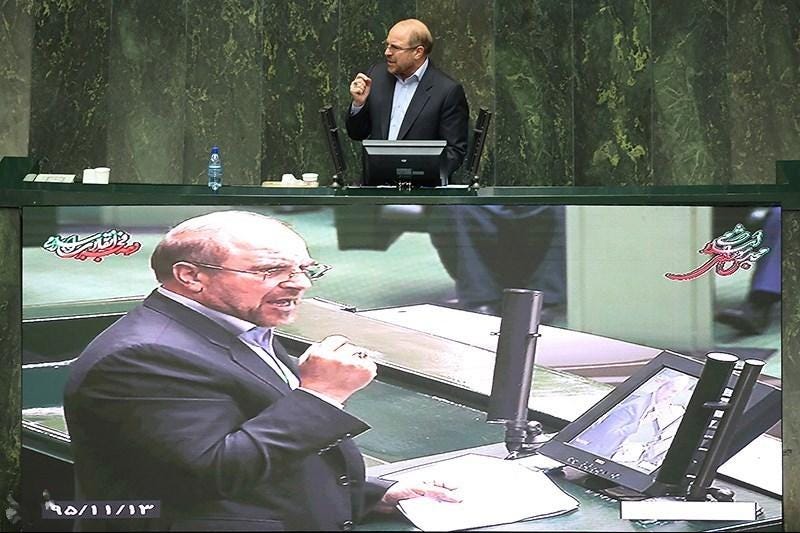

The session carried strong symbolic messages. Lawmakers paid tribute to Ali Khamenei and senior military and political figures killed during the war and chanted slogans calling for “revenge.” A portrait of Mojtaba Khamenei, Iran’s new Supreme Leader, was displayed inside the parliament building. The Majles also approved procedural changes allowing future parliamentary sessions to be held virtually or outside the parliament building during emergency conditions, reflecting the security environment that has shaped Iranian politics since the beginning of the conflict.
The confrontational rhetoric was reinforced further when more than 180 members of parliament signed a public pledge declaring that they would “stand in the line of revenge.” The lawmakers vowed to answer the calls of senior clerics and members of the Assembly of Experts who had declared retaliation against those responsible for killing Iran’s leaders to be a religious obligation. They pledged not to neglect “planning or practical measures” and committed themselves to legislation concerning revenge for those killed in the recent war, the exercise of Iran’s sovereignty over the Strait of Hormuz, and the creation of effective strategic deterrence against future attacks by the United States and Israel.
The letter also revealed continuing frustration within parliament over its four-and-a-half-month suspension. The signatories argued that the overwhelming majority of lawmakers had opposed the prolonged closure of the Majles and believed that its legislative and oversight functions should have resumed much earlier. They implicitly criticized the delay in reopening parliament and argued that the parliamentary rules should have been amended sooner to allow the institution to continue operating under wartime conditions.
The reopening of parliament comes after months of political controversy. Since the beginning of the war, Israel and the United States successfully targeted numerous senior Iranian military and political leaders, forcing much of the country’s leadership into secure locations and effectively preventing parliament from convening.
During the extended break, lawmakers closely associated with the Paydari Front including Hamid Rasai repeatedly demanded that parliament resume its sessions. They openly accused Mohammad Bagher Ghalibaf of deliberately preventing parliament from meeting in order to avoid legislative interference in negotiations with the United States. These same lawmakers consistently opposed diplomacy with Washington and repeatedly called for the resignation of Foreign Minister Abbas Araghchi, one of the principal architects of Iran’s negotiating strategy. Ghalibaf’s allies, however, maintained that the suspension of parliamentary sessions had been ordered by the country’s security authorities rather than by parliament’s leadership.
The session also entailed the formal introduction of the “Strategic Action for the Security and Sustainable Development of the Strait of Hormuz and the Persian Gulf” legislation, a comprehensive maritime security and sovereignty bill governing navigation, access, transit fees, enforcement and Iran’s exercise of jurisdiction in the vital energy waterway. However, this bill should not be interpreted as a victory for the hardline faction. Protecting Iran’s role in securing and managing the Strait of Hormuz has become a matter of broad institutional consensus, supported by officials across the political establishment, including Mohammad Bagher Ghalibaf, President Masoud Pezeshkian, Foreign Minister Abbas Araghchi, the Supreme National Security Council, and the IRGC. The political differences concern implementation and diplomacy—not the strategic importance of Hormuz itself.
The most significant development occurred not in the parliamentary speeches but in the leadership elections of the Majles National Security and Foreign Policy Committee. In the committee’s internal vote, Seyed Mahmoud Nabavian, who had served as First Vice Chairman during the first two years of the current parliament, and Ebrahim Rezaei, who had served as the committee’s spokesman, were both removed from the committee’s leadership.
Instead, lawmakers elected Ebrahim Azizi as chairman, Abbas Moqtadaei and Amir Hayat-Moqaddam as first and second vice chairmen, Hassan Ghashghavi as spokesman, and Bahnam Saeidi and Yaqub Rezazadeh as the committee’s secretaries. This reshuffle is politically important because Nabavian and Rezaei have been among the parliament’s most vocal opponents of negotiations with the United States and leading representatives of the ideological hardline current. Throughout the parliamentary suspension, they repeatedly criticized Ghalibaf and Araghchi, arguing that parliament should take a much more confrontational position toward diplomacy with Washington.
Their removal from the committee’s leadership represents one of the clearest institutional indicators that the hardline faction has failed to translate its wartime visibility into greater political control. This finding is particularly significant when viewed alongside developments over the past week.During Ali Khamenei’s funeral ceremonies, public messaging appeared to be dominated by calls for revenge and by outspoken hardline figures, creating the impression that radicals were emerging as the dominant force within the Islamic Republic following the leadership transition.
The reopening of parliament presents a different picture. Although revolutionary rhetoric remains highly visible, the institutional balance of power continues to favor the more pragmatic establishment represented by Mohammad Bagher Ghalibaf, Masoud Pezeshkian, and Abbas Araghchi. The parliamentary majority did not elevate the leading anti-negotiation figures; instead, it removed two of their most prominent representatives from the leadership of parliament’s most important national security committee.
This suggests that media visibility and political influence should not be confused with institutional authority. Hardline figures continue to shape public discourse and mobilize ideological supporters, but they have not demonstrated that they command the parliamentary support necessary to redirect Iran’s national security or foreign policy.
Taken together, the first parliamentary session after four and a half months of suspension indicates that the post-war political equilibrium remains largely intact. While revolutionary rhetoric continues to serve important symbolic and mobilizational purposes, the governing institutions still appear to be controlled by the more pragmatic coalition that has overseen Iran’s strategic decision-making, diplomacy, and crisis management throughout the conflict. The sidelining of Seyed Mahmoud Nabavian and Ebrahim Rezaei may ultimately prove to be a more meaningful indicator of Iran’s internal political trajectory than the highly publicized rhetoric that dominated Ali Khamenei’s funeral ceremonies.