

Just days after the announcement of the Iran-U.S. memorandum that ended months of conflict, competing visions over maritime security in the Strait of Hormuz are emerging as a flash point that risks undermining ongoing negotiations. An incident today underscores the tensions, with a container ship coming under fire and altering planned transit through the global energy chokepoint.
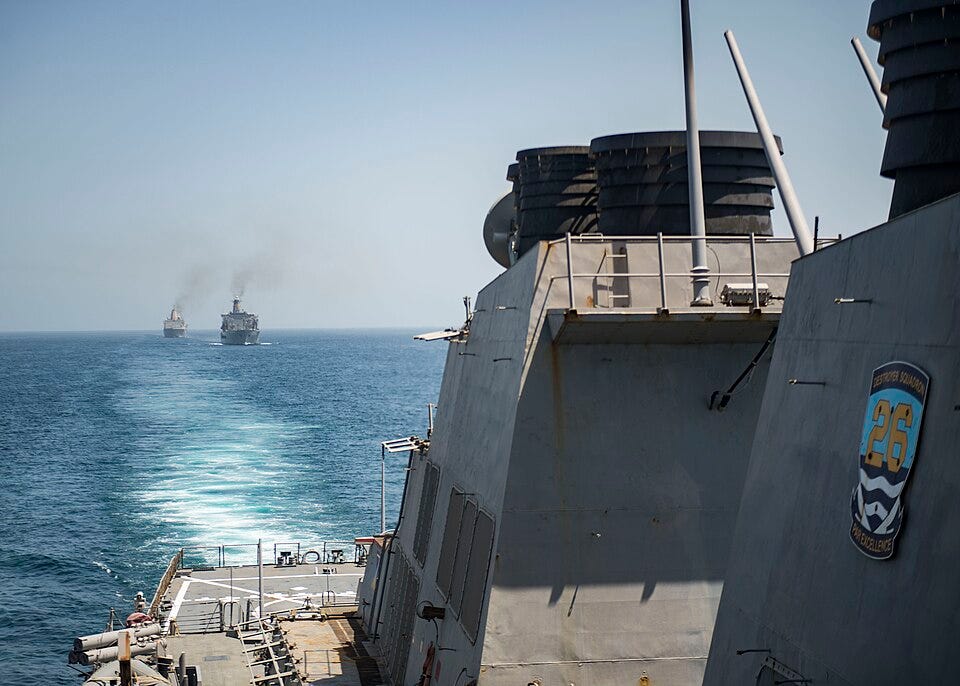
_STRAIT_OF_HORMUZ_TRANSIT_160626-N-GP524-236.jpg)
According to the United Kingdom Maritime Trade Operations (UKMTO), a Singapore-flagged container ship, reportedly the Ever Lovely, was struck by a projectile while transiting near the Strait of Hormuz off the coast of Oman. Maritime security assessments described the incident as a likely attack that damaged the vessel but caused no casualties or environmental damage. Authorities continue to investigate the incident, and responsibility has not been conclusively established. U.S. officials reportedly told Reuters that Iran fired on the vessel, while Tehran had not publicly accepted responsibility at the time of writing.
The reported attack occurred shortly after Iranian authorities warned vessels against using routes not approved by Tehran, which altered the routes of several vessels transiting the Strait of Hormuz. That timing has heightened concern among shipping companies and regional governments, although no direct causal link has been publicly established.
The security incident had immediate operational consequences. The International Maritime Organization (IMO), which had begun coordinating the evacuation of more than 11,000 stranded merchant mariners and hundreds of commercial vessels trapped in the Gulf since the outbreak of the war, announced that it was temporarily suspending its operation. IMO Secretary-General Arsenio Dominguez explained that although the attacked vessel had not been participating in the organization’s evacuation effort, the incident required a reassessment of security guarantees before additional vessels could proceed. The suspension marked the first major interruption to post-war maritime normalization efforts and underscored the fragility of the security arrangements established under the memorandum.
Although the memorandum ended active hostilities and allowed for more intensive diplomatic negotiations, it left unresolved one of the region’s most sensitive strategic issues: who will effectively manage navigation through the Strait of Hormuz after the war. While both Washington and Tehran agree that the waterway should remain open, they appear to hold fundamentally different interpretations of how that objective should be achieved.
Under the memorandum, Iran agreed to facilitate the safe passage of commercial shipping through the Strait of Hormuz during the initial 60-day implementation period without imposing transit fees. In tandem, the U.S. halted its own blockade of the Strait. At the same time, Iranian officials and influential figures close to the negotiating team have made clear that they do not view the agreement as a return to the pre-war status quo. Instead, Tehran appears to be presenting the post-war period as the beginning of a new security and management framework for one of the world’s most strategically important waterways.
Iran’s interpretation is already colliding with the views of the United States, Gulf Arab states, international shipping bodies, and commercial operators. The result is a fast-moving dispute that combines legal claims, military warnings, regional diplomacy, global energy concerns, and continued risks to civilian shipping.
Immediately after negotiations concluded in Switzerland, Iranian parliamentary speaker and chief negotiator Mohammad Bagher Ghalibaf, accompanied by Foreign Minister Abbas Araghchi, traveled to Muscat to meet with Sultan Haitham bin Tariq and Omani Foreign Minister Badr Albusaidi. Following the meetings, Iran and Oman issued a joint statement affirming their commitment to keeping the Strait of Hormuz open and safe for international navigation while simultaneously emphasizing their sovereignty and sovereign rights over their territorial waters.
Notably, the two countries announced plans to establish a joint committee to determine the future management of the Strait and the fees that may be charged for navigation-related services after the initial 60-day transition period. Oman also announced a temporary maritime corridor designed to facilitate commercial shipping and support the evacuation of thousands of merchant mariners stranded in the Gulf since the outbreak of the war.
From Tehran’s perspective, this arrangement appears to reflect a new post-war security architecture in which Iran and Oman would assume a greater role in managing maritime traffic while formally preserving freedom of navigation. Washington, however, has disputed that Iran could impose tolls and otherwise restrict international shipping in the arrangement being negotiated.
The situation escalated after the Islamic Revolutionary Guard Corps Navy issued a sharply worded statement rejecting what it described as the unauthorized announcement of a new navigation route through the Strait of Hormuz. The IRGC declared that only routes approved by the Islamic Republic of Iran are authorized, warning that vessels using alternative corridors would not be recognized under Iran’s security arrangements. According to the statement, ships should coordinate with Iranian authorities through designated communication channels before entering the Strait. The IRGC described any routes announced without Iran’s approval as “unacceptable” and “extremely dangerous.”
Iranian officials have repeatedly emphasized that “the management of the Strait of Hormuz will not return to pre-war conditions,” arguing that the security environment fundamentally changed after the conflict. Some Iranian media outlets also reported that vessels using unauthorized routes could lose safe-passage guarantees and insurance protections under the new framework. Those claims have not been independently verified, but they reflect the broader Iranian effort to signal that shipping companies must take Tehran’s proposed rules seriously.
The dispute was further intensified by comments from Mehdi Mohammadi, an adviser to Mohammad Bagher Ghalibaf, who described the Strait of Hormuz as “the heart of the confrontation” between Iran and its adversaries. Mohammadi argued that the issue of Hormuz is not a temporary technical dispute over shipping routes, but a central component of the post-war order that Iran believes emerged from the memorandum. In his remarks, he suggested that Tehran views the new arrangements as a strategic gain that must be preserved and expanded.
According to Mohammadi, Iran’s policy toward the Strait is built around several principles: generating revenue from the Strait, requiring vessels to use Iran-approved routes, denying passage to ships that Iran considers a threat to its security, and preserving the option of closing the Strait again if necessary. Most notably, he argued that Iran - not outside powers - would determine which passage qualifies as “innocent” and which vessels threaten Iranian security. He also described the policy as permanent, saying Tehran had “fought,” “negotiated,” “written the memorandum,” and “implemented” it on this basis.
These remarks are significant because they indicate that influential figures close to Iran’s negotiating team view the memorandum not merely as a ceasefire mechanism, but as a framework for establishing a more prominent Iranian role in the future security architecture of the Strait of Hormuz. This interpretation directly clashes with the U.S. and Gulf Arab position that the Strait should remain open under existing international navigation rules, without unilateral restrictions or new transit fees.
Iran’s position has immediately generated concern among Gulf Arab states, with many governments asserting that commercial shipping should continue under existing international maritime rules rather than new unilateral arrangements established after the war. The United Arab Emirates warned against what presidential adviser Anwar Gargash described as attempts to impose new geopolitical realities in the Strait, arguing that such actions would create new sources of regional instability rather than lasting peace. Separately, Bahrain publicly welcomed Oman’s temporary maritime corridor and reaffirmed support for maintaining internationally recognized navigation procedures.
The issue quickly became one of the principal topics during the Gulf Cooperation Council ministerial meeting attended by U.S. Secretary of State Marco Rubio. During his tour, Secretary of State Marco Rubio repeatedly argued that no country has the right to impose tolls, transit charges, mandatory routing requirements, or other restrictions on commercial vessels passing through an international waterway. Rubio warned that accepting such a precedent in the Strait of Hormuz could encourage similar claims elsewhere in the world, undermining the legal framework governing global maritime commerce.
At the center of the disagreement is a longstanding legal dispute. The United States and most maritime powers consider the Strait of Hormuz an international strait governed by transit-passage rules under international law. Iran, however, argues that all navigable channels pass through the territorial waters of Iran and Oman, giving the two coastal states greater authority to regulate navigation. Although this disagreement predates the recent conflict, it has become significantly more consequential because it now directly affects implementation of the memorandum.
The Strait of Hormuz has now emerged as another major implementation test of the Iran-U.S. memorandum. While the agreement ended active hostilities, it left unresolved competing visions over who will shape the future security and governance of one of the world’s most important waterways. Whether the parties can bridge these differences during the 60-day implementation period will be a key indicator of whether the memorandum can evolve from a ceasefire into a durable regional agreement.