

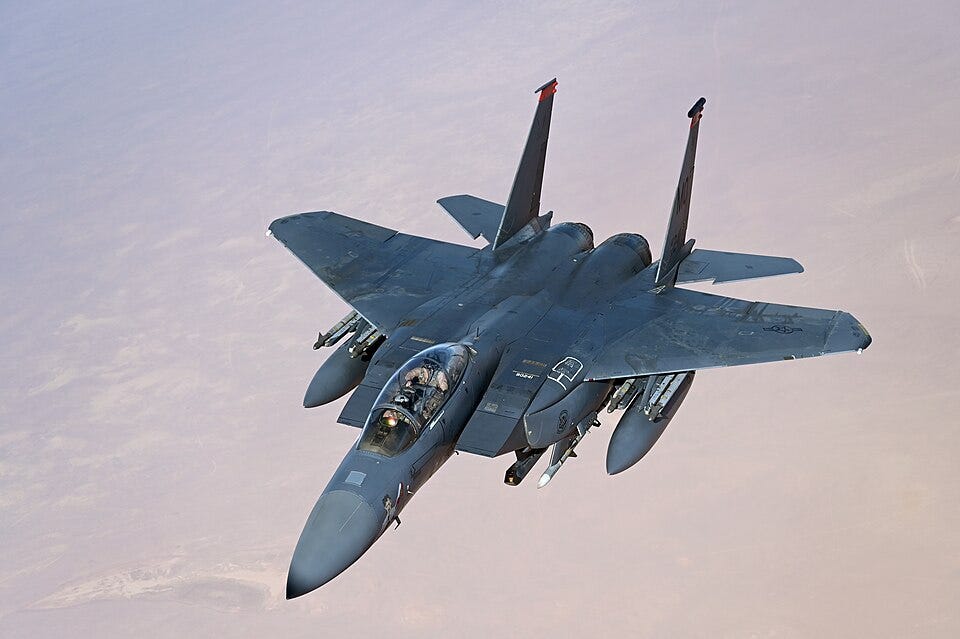
U.S. officials, including President Donald Trump, have proclaimed success in a complex and high-risk search and rescue operation conducted deep inside Iran to recover a second crew member of an American F-15 fighter jet that was shot down inside Iran on April 2. The first crew member had reportedly been rescued in a separate, earlier mission. This second operation on April 4, however, appears to have been significantly larger, longer, and far more resource-intensive, offering a revealing case study of the escalating costs of the current conflict.
According to Trump, the F-15 was struck by a shoulder-fired missile, despite earlier claims that U.S. forces had neutralized much of Iran’s radar infrastructure. He characterized the strike as partly a matter of chance, stating that Iran had “gotten lucky.” However, multiple U.S. aircraft were ultimately destroyed during the broader operation. These remarks reflect a tension between projecting military superiority and confronting unexpected vulnerabilities on the battlefield.
.jpg)
However, available evidence suggests that the incident cannot be reduced to chance alone. In addition to the shootdown of the U.S. F-15E, additional incidents involving a damaged F-35, an A-10 aircraft and drones across the country have been reported. U.S. officials have also acknowledged that American aircraft are being targeted regularly in this conflict, underscoring that Iran retains residual but functional air defense capabilities, even after extensive U.S. and Israeli strikes. Analysts emphasize that a degraded air defense system is not a destroyed one, pointing to the continued effectiveness of short-range and mobile air defense systems. While limited in sophistication, these systems can still pose a serious threat, particularly against aircraft operating at lower altitudes or during complex missions such as combat search and rescue.
Taken together, these developments indicate that Iran maintains a localized, limited air defense network capable of endangering and contesting U.S. and Israeli air operations. While these systems do not fundamentally challenge overall U.S. air superiority, they introduce persistent tactical risk, making clear that such losses are not merely the result of chance, but rather the consequence of operating in an environment where even degraded defenses remain capable.
Beyond official statements, additional accounts describe a ground component to the second rescue operation, involving the insertion of U.S. special operations forces into a rural area in southern Isfahan province. These reports suggest that American forces may have leveraged detailed terrain knowledge, including the identification of short agricultural airstrips used for crop-spraying aircraft, which were repurposed as improvised landing zones for specialized aircraft and helicopters.
There are also indications that psychological operations were employed to create confusion about the pilot’s location, potentially delaying both civilian and military responses. At the same time, U.S. forces appear to have taken steps to temporarily isolate the area, possibly through limited road denial measures, to secure a narrow window for extraction. While the full extent of these activities remains unverified, they are consistent with efforts to manage risk in a highly-contested environment.
President Trump stated that U.S. forces were present inside Iran for up to 48 hours during this second operation. He further described a large-scale mobilization of airpower, claiming that as many as 155 aircraft participated, including bombers, fighter jets, refueling aircraft, and dedicated rescue platforms. He emphasized that deception and misdirection were central to the mission, aimed at diverting Iranian attention away from the actual extraction zone.
Some accounts also point to low-altitude rescue flights, highlighting the operational danger faced by aircraft attempting to avoid detection and interception. Trump acknowledged that U.S. forces destroyed certain aircraft on the ground to prevent them from falling into Iranian hands, and that multiple vehicles and aircraft came under fire during the mission.
In addition to its operational complexity, the rescue mission appears to have come at a substantial material and human cost. Based on available information, the United States likely lost a F-15E fighter jet, an A-10 aircraft, at least two special operations transport planes that were reportedly destroyed after sustaining damage, and small helicopters, bringing the equipment losses to hundreds of millions of dollars, with broader operational costs likely far higher when factoring in the scale of deployed assets. Beyond financial costs, the operation involved a significant exposure of personnel, with estimates suggesting that dozens and potentially up to around 100 U.S. special operations forces and support personnel were placed in or near hostile territory during the mission. This level of risk underscores the lengths required to recover a single individual in contested conditions.
Iranian officials touted the destruction of American aircraft, portraying it as a significant victory even as the pilots were recovered, with state media drawing a contrast to the failed 1980 Operation Eagle Claw. That special forces operation had been ordered to rescue American hostages held in Iran, but led to the loss of eight American servicemembers in an accident.
The fog of war and competing narratives continue to obscure a fully-verified account of the past weekend’s operations. Some observers have noted the proximity of the rescue operation to one of Iran’s core nuclear facilities at Isfahan, where roughly half of Iran’s enriched uranium stockpile is believed to be buried, speculating that part of the goal of the operations may have been to raid the facility or prepare the groundwork for an extraction of the stockpile. Such a raid has been discussed as a possibility in U.S. media. However, this speculation remains unconfirmed.
The operation appears to have demonstrated a broader dynamic of the conflict: the United States appears to have been able to recover its personnel, but only through a high-risk, resource-intensive mission that exposed significant vulnerabilities and incurred substantial costs. What began with the loss of a single aircraft - during a war whose strategic necessity remains disputed - escalated into a complex operation involving large numbers of aircraft, personnel, and financial resources.
This episode can be seen as a microcosm of the wider conflict. A U.S. airstrike contributes to escalation; Iran responds with defensive action; and the United States is then compelled to deploy even greater force and resources to manage the consequences. Similar dynamics are visible at the strategic level, where actions aimed at pressuring Iran have contributed to regional instability, including disruptions around the Strait of Hormuz, followed by efforts to reverse those same outcomes. Ultimately, the rescue operation underscores a central tension: even when tactically successful, such missions can carry disproportionate costs, raising broader questions about the trajectory of the conflict, the risks of escalation, and the burden placed on both military personnel and public resources.
The push for war against Iran ignores both history and our own commitments. In 1981, the United States entered into the Algiers Accords, a carefully brokered agreement that helped end the Iran hostage crisis and secured the release of 52 American citizens. One of its core provisions was clear: the United States pledged not to intervene politically or militarily in Iran’s internal affairs. That wasn’t a vague statement—it was a formal commitment made on the world stage.
To support a war now is to disregard that promise entirely. It raises serious legal and moral concerns, especially when there has been no formal declaration of war by the U.S. Congress, as required by the Constitution. Beyond legality, the consequences at home are impossible to ignore. Americans are feeling the strain through rising costs, economic instability, and the very real fear of a deepening recession. Prolonging conflict only worsens these conditions.
History shows that diplomacy works when leaders are willing to pursue it. Jimmy Carter demonstrated this through his role in brokering peace between Egypt and Israel, proving that even entrenched conflicts can be resolved without endless violence. That example stands in stark contrast to the idea of a prolonged, “never-ending” war.
A ceasefire is not a sign of weakness—it’s a necessary step toward stability. A permanent ceasefire followed by genuine diplomatic engagement offers a path forward that aligns with both our past commitments and our long-term interests. Peace is not just idealistic; in this case, it is the most practical and responsible solution.